Morgan Silver Dollar Identification Guide: Key Dates, Mint Marks, and Values
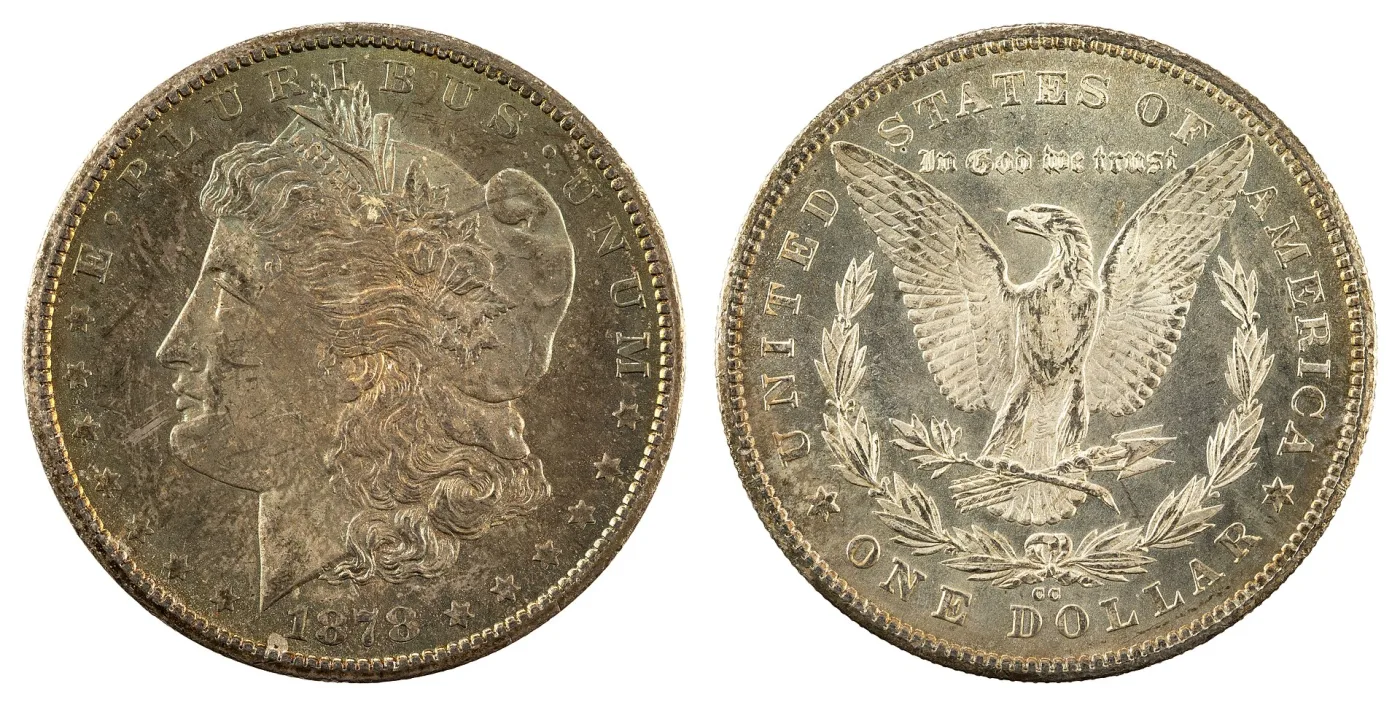
The Morgan Silver Dollar is arguably the most collected and beloved coin in American numismatics. Designed by George T. Morgan and minted from 1878 to 1904, then again in 1921, these 90% silver coins represent a pivotal era in United States history. The Morgan replaced the Seated Liberty Dollar that had been demonetized by the Coinage Act of 1873, restoring silver dollar production after a five-year suspension during which only the export-only Trade Dollar was struck for the China trade. With their substantial size, beautiful design, and rich connection to the American West, Morgan Dollars continue to captivate collectors more than a century after they were first struck.
Whether you’ve inherited a handful of silver dollars, discovered one at an estate sale, or are building a serious collection, knowing how to properly identify a Morgan Dollar is essential. The difference between a common date and a key date coin can mean thousands of dollars in value. Understanding mint marks, die varieties, and grading standards transforms casual interest into informed collecting.
This guide covers everything you need to identify, authenticate, and value Morgan Silver Dollars. You’ll learn to read mint marks, recognize the most valuable dates and varieties, spot counterfeits, and understand the grading system that determines a coin’s market price.
History and Origins of the Morgan Dollar
The Morgan Dollar owes its existence to the Bland-Allison Act of 1878, which required the U.S. Treasury to purchase between two and four million dollars’ worth of silver bullion each month and coin it into silver dollars. This legislation was a direct response to pressure from Western silver mining interests and advocates of bimetallism who wanted silver restored to its role alongside gold as monetary metal.
George T. Morgan, a young British engraver who had been recruited by the U.S. Mint in 1876, was tasked with creating the new dollar design. Morgan used Philadelphia schoolteacher Anna Willess Williams as his model for the Liberty portrait on the obverse. Her profile, adorned with a Phrygian cap wreathed in cotton and wheat, became one of the most recognizable images in American coinage.
Production Timeline
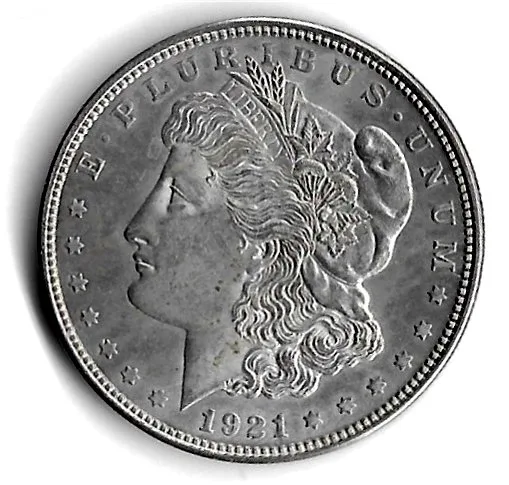
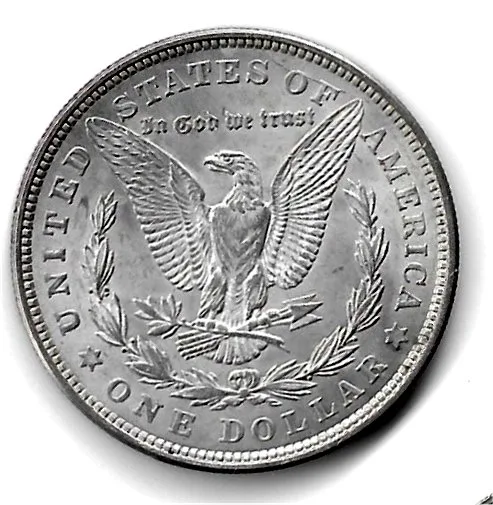
Morgan Dollars were struck continuously from 1878 through 1904, when the Treasury’s silver reserves were finally exhausted. Production ceased for 16 years until the Pittman Act of 1918 necessitated new silver dollars, leading to a final year of Morgan Dollar production in 1921, after which the design was replaced by the Peace Dollar and, decades later, by the modern clad Eisenhower Dollar. During this same era, the Walking Liberty Half Dollar was introduced in 1916 as part of a broader redesign of American silver coinage. Across these years, approximately 657 million Morgan Dollars were struck at five different mints, though many were melted under the Pittman Act, making survivors from certain dates exceptionally rare.
Historical Context
The Morgan Dollar era coincided with some of the most dramatic periods in American history. These coins circulated during the closing of the frontier, the rise of industrial America, the Spanish-American War, and the dawn of the 20th century. Many Morgan Dollars traveled west in the pockets of miners, ranchers, and settlers, giving them a romantic association with the Old West that persists among collectors today. Millions more sat untouched in Treasury vaults, eventually released in the 1960s through the GSA (General Services Administration) sales that sparked a new wave of collecting interest.
Design Elements and Physical Specifications
Accurately identifying a Morgan Dollar starts with understanding its physical characteristics. Every genuine Morgan Dollar shares specific measurements that serve as the first line of defense against counterfeits.
Physical Specifications
- Diameter: 38.1 mm (1.5 inches)
- Weight: 26.73 grams (412.5 grains)
- Thickness: 2.4 mm
- Composition: 90% silver, 10% copper (0.7734 troy ounces of pure silver)
- Edge: Reeded (grooved)
- Designer: George T. Morgan
Obverse (Front) Design
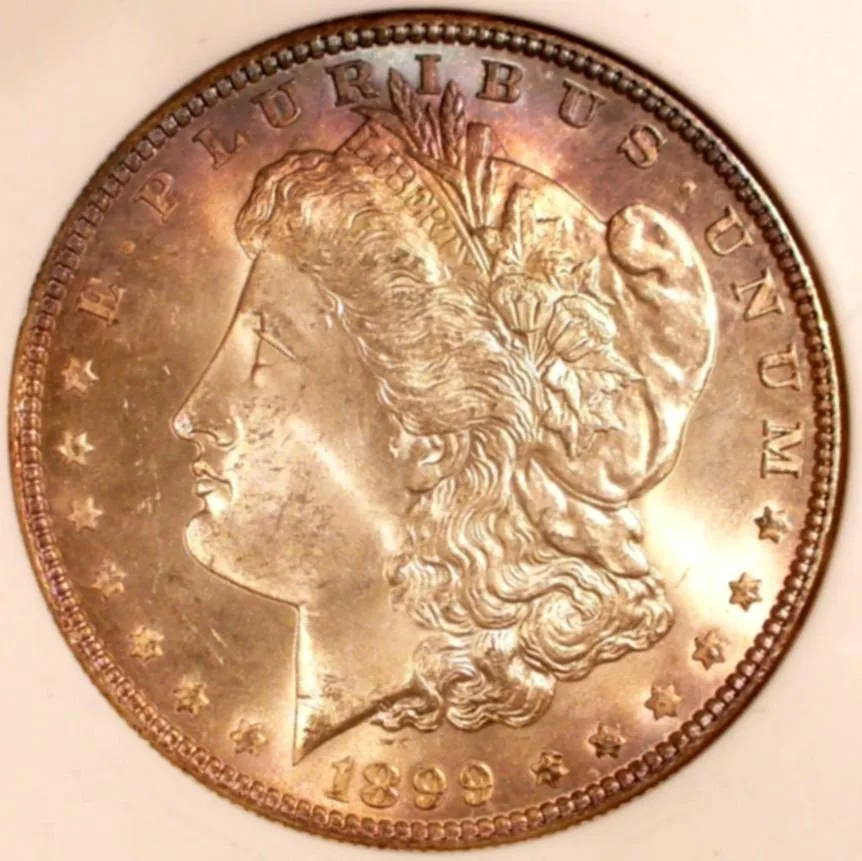
The obverse features a left-facing profile of Lady Liberty wearing a Phrygian cap adorned with a band inscribed “LIBERTY.” The cap is encircled by a wreath of cotton bolls and wheat ears, symbolizing America’s agricultural foundations. Thirteen stars surround Liberty’s portrait, representing the original colonies, with seven stars to the left and six to the right. The date appears at the bottom center, and “E PLURIBUS UNUM” is inscribed along the upper rim.
Reverse (Back) Design
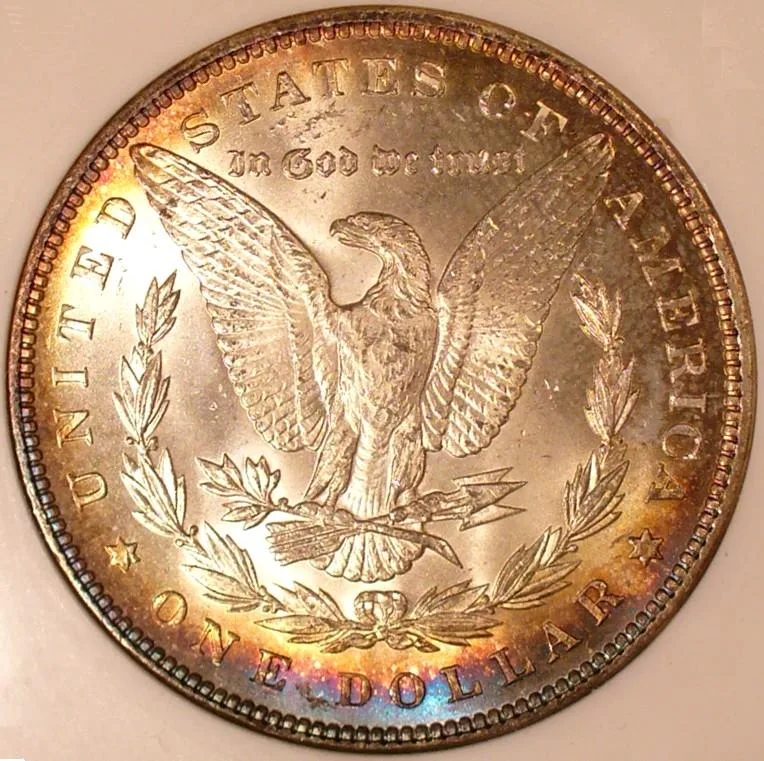
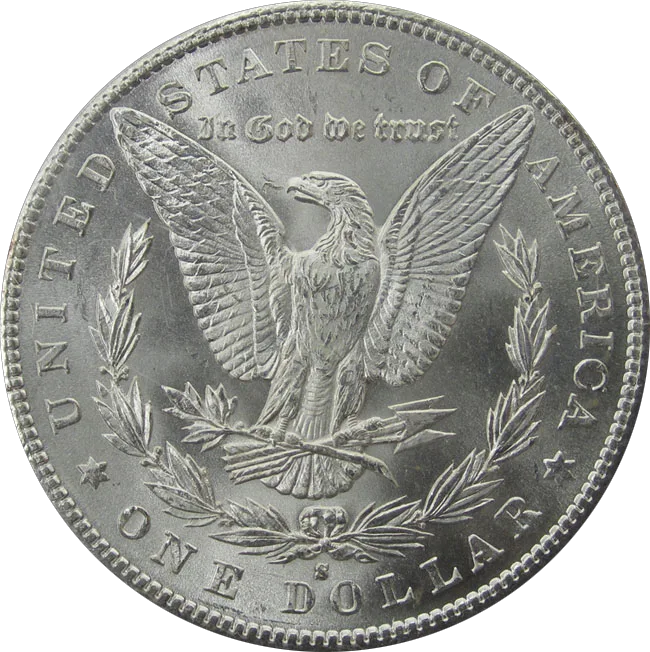
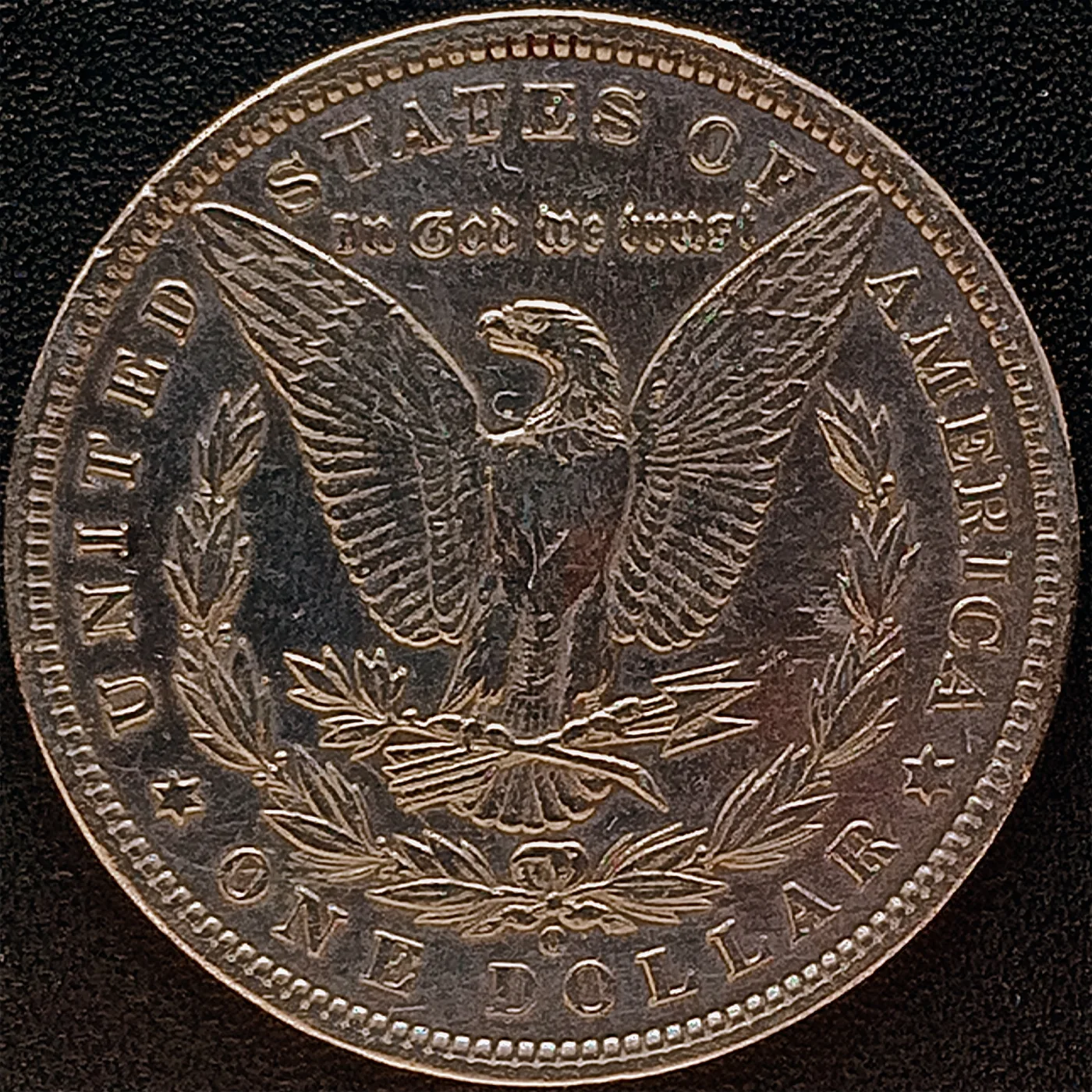
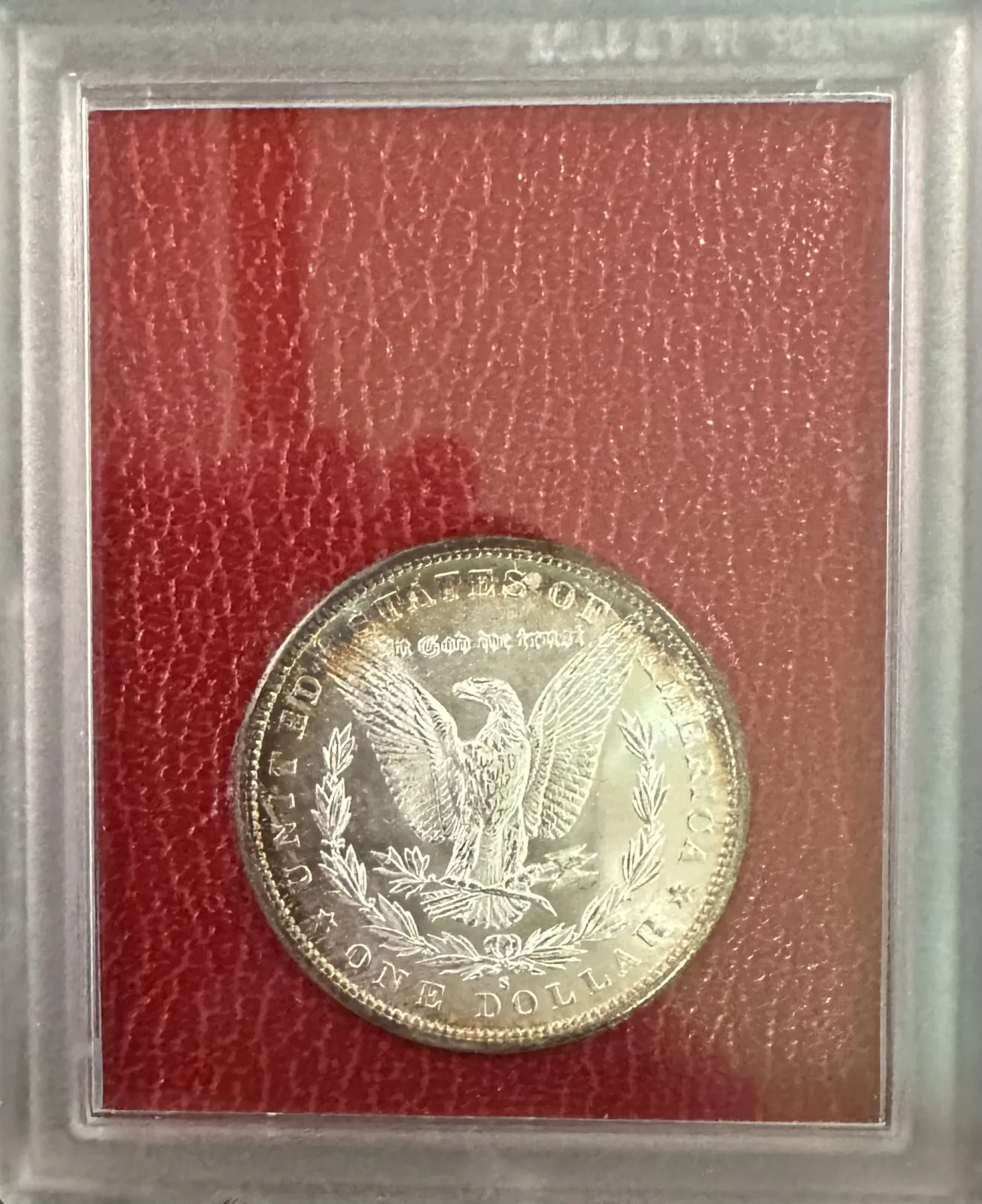
The reverse depicts a heraldic bald eagle with outstretched wings, clutching an olive branch and arrows in its talons. A wreath of laurel encircles the eagle, and “UNITED STATES OF AMERICA” arches across the top. The denomination “ONE DOLLAR” appears below the wreath, and “IN GOD WE TRUST” is positioned above the eagle’s head in Gothic lettering. The mint mark, when present, sits below the bow of the wreath — in the strip of open field between the bottom of the wreath and the words “ONE DOLLAR,” centered on the “D” and “O.” It is not between the bow and the eagle’s tail; the bow is the whole barrier between the two.
Understanding Mint Marks and Minting Facilities
The mint mark is one of the most critical identification features on any Morgan Dollar. It tells you where the coin was produced and can dramatically affect its value. The mint mark location on Morgan Dollars is on the reverse, centered above the letters “DO” in “DOLLAR,” in the field immediately below the bow at the bottom of the wreath.
Philadelphia (No Mint Mark)
The Philadelphia Mint was the primary production facility and struck Morgan Dollars every year of the series (1878-1904, 1921). Philadelphia coins bear no mint mark. As the main mint, Philadelphia generally produced the highest quantities, making most Philadelphia Morgan Dollars relatively common. However, certain years like 1893 and 1895 are notable exceptions with low mintages.
Carson City (CC)
The Carson City Mint in Nevada operated from 1870 to 1893 and produced Morgan Dollars from 1878 to 1893. Carson City coins are identified by the “CC” mint mark and are universally popular with collectors due to their association with the Comstock Lode and the Wild West. Even common-date CC Morgans command significant premiums over their Philadelphia and San Francisco counterparts. Before Morgan production began, Carson City had already struck the legendary 1870-CC Liberty Head Double Eagle, anchoring the mint’s reputation among collectors of US gold.
San Francisco (S)
The San Francisco Mint struck Morgan Dollars from 1878 to 1904 and again in 1921. The “S” mint mark identifies these coins. San Francisco coins tend to be well-struck with sharp details, as the mint had a reputation for quality. The 1893-S is the single rarest regular-issue Morgan Dollar, with a mintage of just 100,000 pieces.
New Orleans (O)
The New Orleans Mint produced Morgan Dollars from 1879 to 1904, identified by the “O” mint mark. New Orleans coins are known for their sometimes weaker strikes and varied quality, which actually makes well-struck examples more desirable. Several New Orleans dates are considered semi-key issues, including the 1895-O and 1903-O.
Denver (D)
The Denver Mint only struck Morgan Dollars in the final year of production, 1921, identified by the “D” mint mark. The 1921-D is readily available due to its high mintage of over 20 million coins, but gem-quality examples with full luster can still command strong prices.
Key Dates and Rarities
Understanding which dates are rare and valuable is fundamental to Morgan Dollar collecting. Key dates are coins with low mintages, low survival rates, or both. Here are the most important dates every collector should know.
The “Big Three” Rarities
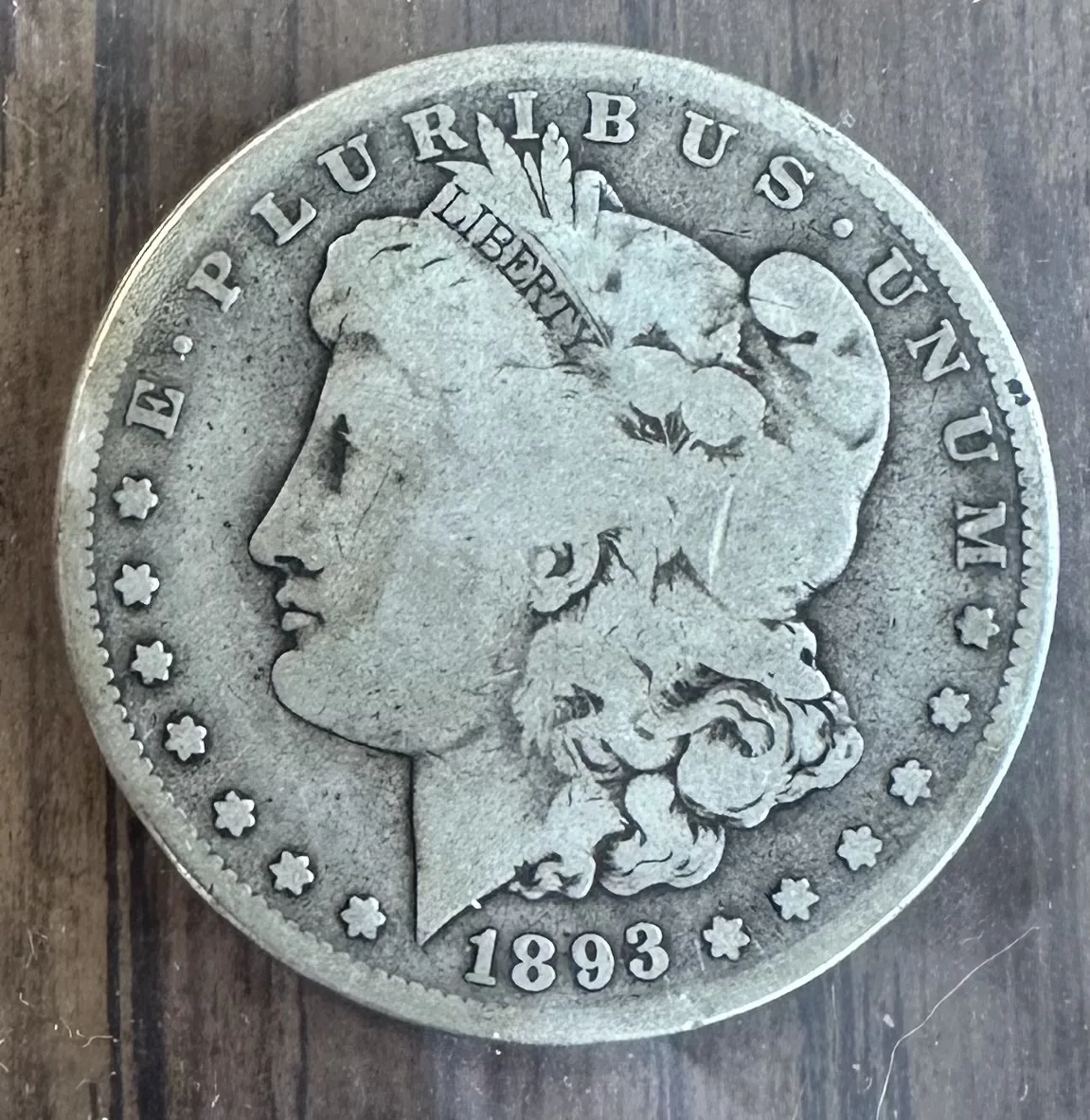
- 1893-S: The undisputed king of Morgan Dollar rarities in circulation strikes. Only 100,000 were minted, and far fewer survive today. Even in heavily worn condition, an 1893-S commands prices starting around $5,000-$8,000, with mint-state examples reaching six figures.
- 1895 (Proof Only): No circulation strikes were produced at Philadelphia in 1895, despite a reported mintage of 12,000. Only 880 proof specimens were struck, making this the most coveted Morgan Dollar. Genuine examples sell for $30,000 and up.
- 1889-CC: With a mintage of just 350,000 and heavy circulation in the Nevada mining regions, surviving 1889-CC Morgans are quite rare. Values start around $1,500 in lower grades and climb rapidly for better examples.
Semi-Key Dates
- 1879-CC: Low mintage of 756,000 with relatively few survivors
- 1881-CC: Mintage of 296,000, though many were preserved in Treasury vaults
- 1884-CC: Only 1,136,000 struck, but GSA hoard releases added many to the market
- 1892-S: Mintage of 1,200,000 with a low survival rate
- 1893: Philadelphia issue with only 378,000 minted
- 1893-CC: The final Carson City Morgan with 677,000 struck
- 1893-O: Just 300,000 minted at New Orleans
- 1895-O: Low mintage of 450,000 with very few uncirculated survivors
- 1895-S: Only 400,000 struck at San Francisco
- 1903-O: Once considered very rare until a Treasury vault release in the 1960s
Conditionally Rare Dates
Some Morgan Dollars are common in circulated grades but extremely rare in mint state. These “conditionally rare” coins can surprise collectors with their values in higher grades. Examples include the 1884-S, 1885-S, 1886-O, and 1892-O, all of which are affordable in Fine or Very Fine condition but command serious premiums in MS-63 or better.

VAM Varieties: Die Varieties Worth Knowing
VAM stands for Van Allen-Mallis, named after researchers Leroy Van Allen and A. George Mallis who cataloged thousands of die varieties in their landmark reference work, The Comprehensive Catalog and Encyclopedia of Morgan and Peace Dollars. VAM collecting adds an entirely new dimension to the Morgan Dollar series, and certain varieties can be worth significantly more than standard examples.
What Creates a VAM Variety
VAM varieties result from differences in die production and use. These include doubled dies (where the design is impressed into the die more than once at slightly different positions), repunched dates or mint marks, die cracks, die clashes (when the obverse and reverse dies strike each other without a coin blank between them), and filled dies where debris alters the design.
The Top 100 VAMs
Of the more than 10,000 cataloged VAM varieties, the “Top 100” list highlights the most significant and collectible. These are varieties that combine rarity, visual drama, and collector demand. Some notable Top 100 VAMs include:
- 1878 8 Tail Feathers: The original design with eight tail feathers on the eagle, struck only at Philadelphia with a mintage around 750,000 before the design was revised
- 1878 7/8 Tail Feathers: A transitional variety showing remnants of the original eight-feather design beneath the revised seven-feather design
- 1888-O “Hot Lips” (VAM-4): A dramatically doubled die variety showing a clear secondary image on Liberty’s portrait, creating a “double profile” effect that makes it one of the most visually striking Morgan Dollar varieties
- 1887 7/6 Overdate: Shows traces of an underlying “6” beneath the final digit, indicating the die was first punched with an 1886 date
- 1880-O 8/7 Overdate: The “8” in the date clearly shows a “7” underneath
How to Identify VAM Varieties
Identifying VAMs requires a good magnifying loupe (at least 10x, preferably 15x) and patience. Focus on these areas when examining your Morgan Dollars:
- Date digits: Look for repunched numbers, overdates, or misplaced date elements
- Mint mark: Check for repunched, tilted, or doubled mint marks
- Liberty’s ear and eye: Many obverse VAMs show doubling in these areas
- Eagle’s breast feathers and tail feathers: Reverse VAMs often show die clashes or doubling here
- “LIBERTY” headband: Doubling and die polishing variations are common
- Stars: Repunched or shifted stars identify certain varieties
Grading and Condition Assessment
The condition of a Morgan Dollar is the single biggest factor affecting its value after rarity. Professional grading uses the Sheldon grading scale from 1 to 70, with higher numbers indicating better condition. Understanding these grades helps you accurately assess what your coins are worth.
Circulated Grades
- AG-3 (About Good): Heavily worn with the outline of the design barely visible. Liberty’s head is a smooth silhouette. Only the most valuable dates retain significant value at this grade.
- G-4/G-6 (Good): Major design elements visible but flat. “LIBERTY” on the headband is worn smooth. Stars and date are readable. The eagle on the reverse shows the outline but lacks detail.
- VG-8/VG-10 (Very Good): Some letters of “LIBERTY” beginning to show. Hair details emerging around the ear. Eagle’s wings show some feather separation.
- F-12/F-15 (Fine): “LIBERTY” fully readable though not sharp. Hair strands above the ear are visible. Eagle shows moderate feather detail. Most stars show their interior lines.
- VF-20/VF-35 (Very Fine): Hair detail sharp above and below the ear. Cotton bolls and wheat in the wreath show clear detail. Eagle’s breast feathers are visible. A popular grade for type collectors balancing cost and eye appeal.
- EF-40/EF-45 (Extremely Fine): Only slight wear on the highest points: the cheek, the hair above the ear, and the eagle’s breast. Most original detail intact. Traces of mint luster may be visible in protected areas.
- AU-50/AU-58 (About Uncirculated): Minimal wear visible only on the highest points under magnification. Significant mint luster remains. AU-58 coins are often nearly indistinguishable from lower mint-state grades to the untrained eye.
Mint State Grades
- MS-60 to MS-62: No wear, but heavy contact marks, bag marks, or dull luster. These are coins that never circulated but were jostled in mint bags. Common for Morgan Dollars that sat in Treasury bags for decades.
- MS-63 (Choice Uncirculated): Moderate contact marks with attractive luster. A popular grade for collectors seeking uncirculated coins at reasonable prices.
- MS-64 (Near Gem): Light contact marks, strong luster, good eye appeal. The “sweet spot” for many collectors balancing quality and affordability.
- MS-65 (Gem Uncirculated): Minor contact marks visible only under magnification. Strong, even luster and excellent eye appeal. A significant jump in value from MS-64 for most dates.
- MS-66 and above: Nearly flawless surfaces with exceptional luster and strike. These premium grades command exponentially higher prices and are scarce for most dates.
Strike Quality
Beyond the numerical grade, strike quality significantly affects a Morgan Dollar’s desirability. A well-struck coin shows sharp, fully defined details in the hair above Liberty’s ear on the obverse and complete separation of the eagle’s breast feathers on the reverse. Weakly struck coins, common among New Orleans mint issues, may technically grade high but lack visual appeal. Collectors and dealers often note strike quality separately from the overall grade.
Authentication and Counterfeit Detection
The Morgan Dollar’s popularity and high values for key dates make it the single most frequent target for counterfeiters. Learning how to spot fake coins — through weight, magnet, ping, and edge tests — protects your investment and ensures the integrity of your collection. Authentication is a critical skill in coin identification broadly, but it is especially important for high-value series like the Morgan Dollar.
Weight and Dimension Tests
Every genuine Morgan Dollar weighs 26.73 grams and measures 38.1 mm in diameter. An accurate digital scale reading 0.01 grams and a set of digital calipers are your first defense against counterfeits. Deviations of more than 0.2 grams from the standard weight are a strong indicator of a fake. Many counterfeits, especially cast copies, will be slightly overweight or underweight.
Visual Red Flags
- Mushy or soft details: Cast counterfeits typically lack the sharp, crisp detail of struck coins. Look especially at the hair strands above Liberty’s ear and the eagle’s breast feathers.
- Wrong luster: Genuine Morgan Dollars have a characteristic “cartwheel” luster when rotated under a light. Counterfeits often appear dull, greasy, or uniformly shiny.
- Seam lines: Cast fakes may show a faint seam around the rim where the mold halves met.
- Incorrect edge reeding: Look at how the reeding is made rather than counting it: on a struck coin the grooves are even in depth, evenly spaced, and square to the edge, while cast and pressed fakes show shallow, uneven or wandering reeds. Reed counts are published as a specification and are worth comparing against a catalogue, but a count taken by eye on a worn or cleaned edge is not a pass/fail test and should not be used to reject a coin on its own.
- Altered dates or mint marks: Examine the date and mint mark under magnification for signs of tooling, added metal, or removal. A common fraud is adding a “CC” mint mark to a Philadelphia coin or altering a common date to a rare one.
The “Ping” Test
Silver has a distinctive, high-pitched ring when tapped against another coin or balanced on a fingertip and lightly struck. Base metal counterfeits produce a dull thud. While not definitive on its own, the ping test combined with weight verification catches most crude counterfeits.
Professional Authentication
For valuable coins, professional grading and authentication from services like PCGS (Professional Coin Grading Service) or NGC (Numismatic Guaranty Corporation) provides the highest level of confidence. These services encapsulate coins in tamper-evident holders with a guaranteed grade. For any Morgan Dollar worth more than a few hundred dollars, professional authentication is a worthwhile investment.
Valuation and Current Market Pricing
Morgan Dollar values depend on three primary factors: date and mint mark rarity, condition (grade), and current market demand. Understanding how these factors interact helps you make informed buying and selling decisions.
Common Date Values
Many Morgan Dollar dates are considered “common” with mintages in the millions and abundant surviving populations. Common-date Morgans in circulated grades (VG through AU) typically sell for modest premiums over their silver melt value, which fluctuates with the spot price of silver. In mint state, even common dates command premiums based on eye appeal and grade, with MS-63 examples typically starting in the $50-$80 range and MS-65 examples reaching $150-$400 depending on the specific date.
Semi-Key and Key Date Values
Semi-key dates like the 1879-CC, 1892-S, and 1893-O carry significant premiums across all grades. Values for these coins typically start at several hundred dollars in lower circulated grades and increase dramatically in uncirculated condition. True key dates like the 1893-S and 1895 Proof are five- and six-figure coins in most grades, with prices continuing to rise as collectors compete for a shrinking supply.
Factors That Increase Value
- Original toning: Natural, attractive toning that develops over decades can significantly enhance a coin’s value, sometimes doubling the price of a white example
- Proof-like surfaces: Some Morgan Dollars struck from freshly polished dies exhibit mirror-like fields, designated as PL (Proof-Like) or DMPL (Deep Mirror Proof-Like), which adds substantial premiums
- GSA holder: Carson City Morgans in original GSA (General Services Administration) holders from the 1970s-80s government sales carry premiums for their provenance
- Notable pedigree: Coins from famous collections or notable hoards may command auction premiums
The 1878 First-Year Varieties
The first year of Morgan Dollar production offers some of the most interesting varieties in the entire series. Three distinct tail feather configurations exist, each representing a chapter in the coin’s early design evolution.
8 Tail Feathers (8TF)
The original design featured eight tail feathers on the eagle. This variety was struck only at Philadelphia with an estimated mintage of around 750,000 before the Mint decided to reduce the feather count. The 8TF variety is readily identifiable by counting the long tail feathers extending below the eagle’s body. Collectors prize this as the first variety of the first year, and values are moderate to strong depending on grade.
7 over 8 Tail Feathers (7/8TF)
When the dies were modified to show seven tail feathers, the recutting left traces of the original eighth feather visible between the remaining seven. This transitional variety shows clear evidence of the design change and is popular with variety collectors. Under magnification, you can see vestiges of the eighth feather, particularly between the central and rightmost tail feathers.
7 Tail Feathers (7TF)
The final, standard design shows seven tail feathers and became the norm for all subsequent Morgan Dollars through 1921. Within the 1878 7TF category, there are further subdivisions based on the style of the eagle’s tail feathers: the Reverse of 1878 (parallel top arrow feather) and the Reverse of 1879 (slanted top arrow feather), adding further collecting possibilities.
Carson City Morgan Dollars
No discussion of Morgan Dollars is complete without special attention to the Carson City issues. The “CC” mint mark carries an almost legendary status among collectors, combining relative scarcity with the romantic history of the Nevada mining frontier.
Why CC Morgans Are Special
The Carson City Mint was established in 1870 primarily to process the massive silver output from the Comstock Lode. Its location in Nevada, far from the eastern establishment, gives CC-mintmark coins a frontier mystique. The mint operated with smaller equipment and lower production volumes than Philadelphia or San Francisco, resulting in lower mintages across the board. Additionally, CC Morgans saw heavy circulation in the mining regions of the West, meaning fewer survived in high grades.
The GSA Hoard
In the 1960s and 1970s, the U.S. government discovered millions of uncirculated silver dollars stored in Treasury vaults, including many Carson City Morgans. The General Services Administration held public sales from 1972 to 1980, offering these coins in hard plastic holders with certificates of authenticity. GSA-holder CC Morgans remain highly collectible, with the original holders adding 10-30% premiums. The most common GSA dates are 1882-CC, 1883-CC, and 1884-CC, while 1879-CC and 1893-CC are very rare in GSA holders.
CC Morgan Dollar Year-by-Year Highlights
- 1878-CC: First Carson City Morgan. Mintage: 2,212,000. Relatively available but popular as a first-year type coin.
- 1879-CC: Key date. Mintage: 756,000. Clear CC over CC repunched mint mark known. Scarce in all grades.
- 1880-CC: Mintage: 591,000. Multiple reverse varieties (8/7 overdate). GSA examples available but declining in supply.
- 1881-CC: Low mintage of 296,000. Many survivors come from the GSA hoard. A key date in circulated grades.
- 1882-CC to 1884-CC: Moderate mintages, with many saved in Treasury vaults. Common in GSA holders but scarce in circulated condition (most were never released into commerce).
- 1885-CC: Mintage: 228,000. One of the lower-mintage CC issues, but GSA releases brought many to market.
- 1889-CC: Major key date. Mintage: 350,000 with very heavy circulation losses. The most valuable CC Morgan in circulated grades.
- 1890-CC to 1891-CC: Moderate mintages. Good entry-level CC Morgans for new collectors.
- 1892-CC: Mintage: 1,352,000. Common for a CC Morgan but still carries the CC premium.
- 1893-CC: The last Carson City Morgan. Mintage: 677,000. Popular as a “last year” type coin with strong collector demand.
Proper Storage and Preservation
Protecting your Morgan Dollars from environmental damage is essential for maintaining their value and historical integrity. Silver is a reactive metal that tarnishes when exposed to sulfur compounds, moisture, and certain chemicals. Proper storage prevents damage that could significantly reduce a coin’s grade and market value.
Recommended Storage Methods
- Certified holders (slabs): Coins graded by PCGS or NGC are sealed in inert, tamper-evident plastic holders that provide excellent long-term protection. This is the gold standard for valuable coins.
- Air-Tite capsules: Snap-together acrylic capsules sized specifically for the 38.1mm Morgan Dollar. These provide excellent protection at low cost and allow both sides to be viewed without handling.
- 2x2 Mylar flips: Inert, non-PVC flips are acceptable for short-term storage and organizing. Avoid soft vinyl flips, which contain PVC that produces green residue and damages coins over time.
- Archival albums: Dansco and Whitman albums with acid-free pages are popular for building date sets. Ensure the album slides are free of PVC.
Environmental Controls
Store your collection in a cool, dry environment with stable temperatures. Ideal conditions are 65-70 degrees Fahrenheit with 35-45% relative humidity. Avoid attics, basements, garages, and any location subject to temperature swings. Include silica gel packets in your storage area to absorb excess moisture, and replace them periodically.
Handling Best Practices
Always hold coins by their edges, never touching the obverse or reverse surfaces. Oils from your fingers can leave permanent marks that reduce a coin’s grade. When examining raw (uncertified) coins, work over a soft surface like a velvet pad to prevent damage if the coin is dropped. Wash and thoroughly dry your hands before handling, or use clean cotton gloves.
Building a Morgan Dollar Collection
Morgan Dollars offer multiple collecting strategies to suit every budget and interest level. Whether you’re drawn to the challenge of a complete date-and-mint set or prefer focusing on a specific aspect, the series provides decades of collecting enjoyment.
Type Collecting
The simplest approach is acquiring one representative example from each mint: a Philadelphia (no mint mark), Carson City (CC), San Francisco (S), New Orleans (O), and Denver (D). This five-coin type set gives you a cross-section of the series at minimal cost. Many collectors pair Morgan Dollars with other iconic series from the same era, such as the Indian Head Penny, the Buffalo Nickel, and the Mercury Dime, to build a broader type collection spanning the late 19th and early 20th centuries.
Date Sets
A complete date set includes one Morgan Dollar from each year of production (1878-1904, 1921), regardless of mint mark. This is achievable for most collectors, as you can select the most affordable mint mark for each year. The 1895 remains the major obstacle, as only proofs exist, but the remaining dates are attainable in circulated grades.
Complete Date and Mint Mark Set
The ultimate Morgan Dollar challenge is assembling every date-and-mint combination. A complete set includes approximately 97 coins (exact count depends on how you classify the 1878 varieties). Several coins in this set are expensive key dates, making completion a long-term goal requiring significant investment. Many collectors focus on circulated grades (VF to AU) to keep costs manageable while still building an impressive set.
Specialty Collecting
- Carson City Morgans: All 13 CC dates (1878-1885, 1889-1893) make a self-contained and historically significant mini-set
- Toned Morgans: Collecting for beautiful natural toning adds an artistic dimension
- VAM collecting: Pursuing die varieties within specific dates offers endless discovery
- GSA Morgan Dollars: Building a set of CC Morgans in original government holders
- Proof Morgan Dollars: A high-end pursuit focusing on the small number of proof coins struck each year from 1878 to 1904
Buying Tips for New Collectors
Start with common-date coins to learn the series before investing in expensive key dates. Buy the best grade you can afford rather than accumulating many low-grade examples. Purchase certified coins (PCGS or NGC) for any coin worth over $100 to ensure authenticity and accurate grading. Build relationships with reputable dealers, attend coin shows to examine coins in person, and use price guides like the PCGS Price Guide and NGC Census to understand market values before buying.
Conclusion
The Morgan Silver Dollar stands as one of the most rewarding series in American numismatics. From common-date coins accessible to beginning collectors to six-figure rarities that challenge advanced numismatists, the series offers something for everyone. By mastering the identification skills covered in this guide, from reading mint marks and recognizing key dates to spotting VAM varieties and detecting counterfeits, you’re equipped to navigate the Morgan Dollar market with confidence.
Remember that every Morgan Dollar is a tangible connection to America’s Gilded Age, a piece of silver that may have traveled in the pockets of miners, sat in bank vaults for a century, or passed through countless hands in commerce. Understanding these coins enriches both their monetary and historical value. Take your time, study each coin carefully, and enjoy the journey of discovery that Morgan Dollar collecting provides.