Draped Bust Dime Identification Guide: Small Eagle, Heraldic Eagle, the 1796 First Year, Star Counts, JR Varieties, and Values
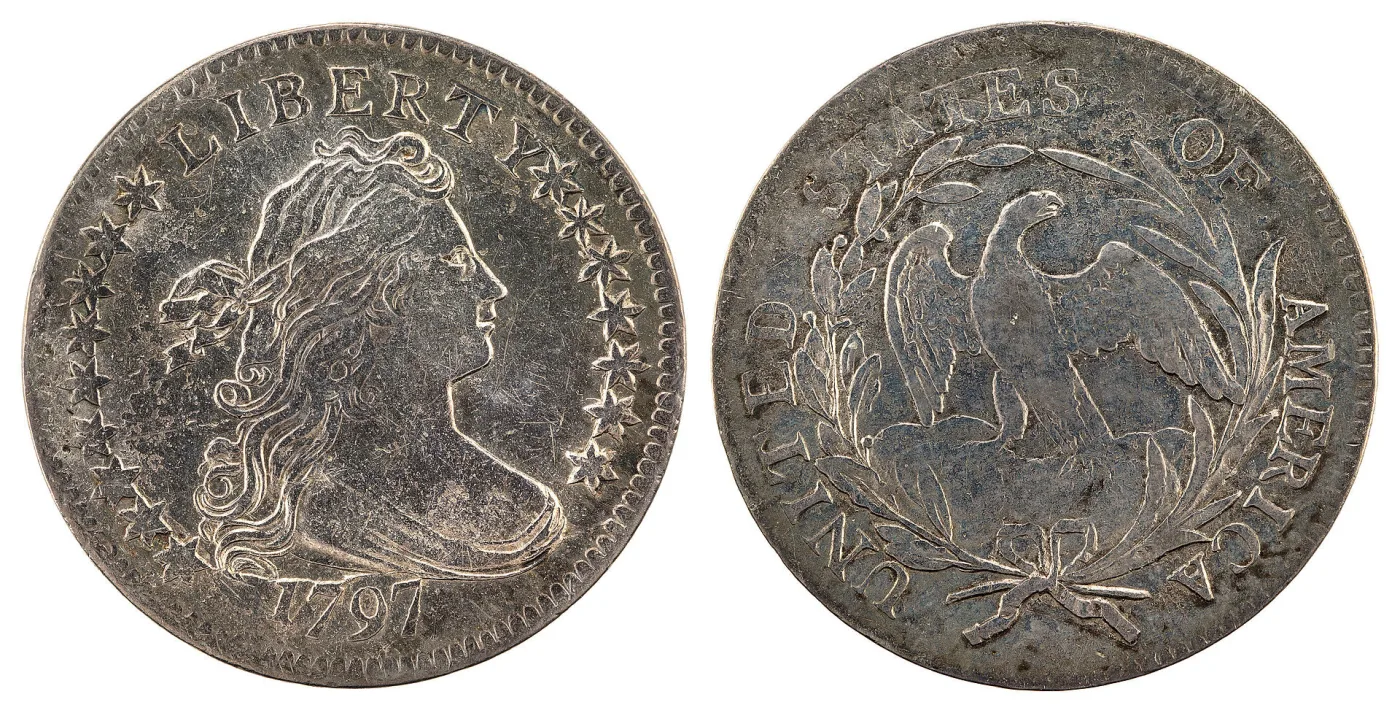
The Draped Bust Dime ran from 1796 to 1807 and holds a special place in American numismatics: it is the very first ten-cent piece struck by the United States Mint. Designed by Chief Engraver Robert Scot from a Gilbert Stuart sketch — the same elegant Liberty portrait that appeared across the entire late-1790s federal coinage — the series is short, scarce, and historically irresistible. Across just twelve years it splits into two distinct reverse types, the delicate Small Eagle (1796-1797) and the busier Heraldic Eagle (1798-1807), and it offers a one-year-only 1796 first-year issue that ranks among the most coveted early type coins in the entire US series.
This guide walks through every aspect of identifying, attributing, grading, and valuing Draped Bust Dimes. You’ll learn how to separate the Small Eagle from the Heraldic Eagle at a glance, decode the confusing star-count varieties (13, 15, and 16 stars on the obverse; 13 and 16 on the reverse), navigate the JR die-variety system catalogued by the John Reich Society, recognize every key date and overdate, weigh and authenticate suspect coins, grade with the Sheldon scale, and price your dimes accurately at today’s market. Because the entire series is rare, even heavily worn examples carry strong numismatic premiums far above their tiny silver content.
Whether you have inherited a single early dime, are filling the first slot in a US type set, or are pursuing a complete date-and-variety run, this guide will give you the working knowledge to identify any Draped Bust Dime with confidence.
History: America’s First Dime
The Coinage Act of 1792 authorized a “disme” (an archaic spelling of dime) valued at one-tenth of a dollar, but the young Philadelphia Mint did not strike any for circulation until 1796. The first denominations off the presses were the silver dollar, half dollar, and half dime in 1794-1795, followed by the dime, quarter, and the gold and copper coinage as the Mint’s capacity grew. The dime debuted in 1796 carrying Robert Scot’s Draped Bust design — already in use on the silver dollar and half dime — paired with a small, naturalistic eagle reverse.
The Draped Bust Dime is a short series: it was struck in 1796, 1797, 1798, 1800, 1801, 1802, 1803, 1804, 1805, and 1807. No dimes were struck in 1799 or 1806, and the Small Eagle reverse lasted only two years before being replaced. Mintages throughout were tiny by modern standards — often well under 100,000 coins per year, and in some years only a few thousand survive today. This scarcity, combined with the historical cachet of being the nation’s first dime, makes every date desirable.
The series ended in 1807. After a one-year pause, the dime returned in 1809 with John Reich’s new Capped Bust Dime, which would carry the denomination through 1837. The Draped Bust Dime therefore represents the entire first generation of US ten-cent coinage and is the essential first piece in any dime type set.
The Designer: Robert Scot
Robert Scot (c. 1745-1823) was the first Chief Engraver of the United States Mint, appointed in 1793. A Scottish-trained engraver who had worked as a banknote and seal engraver in Virginia and Philadelphia, Scot designed nearly all of the earliest US coinage, including the Flowing Hair Dollar, the Draped Bust series across every denomination, and the early gold eagles. His Draped Bust Liberty was based on a drawing by the celebrated portraitist Gilbert Stuart, reportedly modeled on Philadelphia socialite Ann Willing Bingham. The same portrait unifies the dime with its sister coins — the Draped Bust Half Dime, the Draped Bust Quarter, and the Draped Bust Dollar — making it one of the most recognizable design families in American coinage.
Scot’s work has sometimes been criticized as workmanlike rather than artistic, but the Draped Bust portrait is widely admired for its softness and grace. Because every die was hand-engraved at the Mint, Scot’s basic hub produced dozens of subtly different working dies, which is the foundation of the rich die-variety scene that specialists prize today.
Design: Scot’s Draped Bust Liberty
Understanding every design element is essential for accurate type identification, JR variety attribution, and authentication.
Obverse (Heads Side)
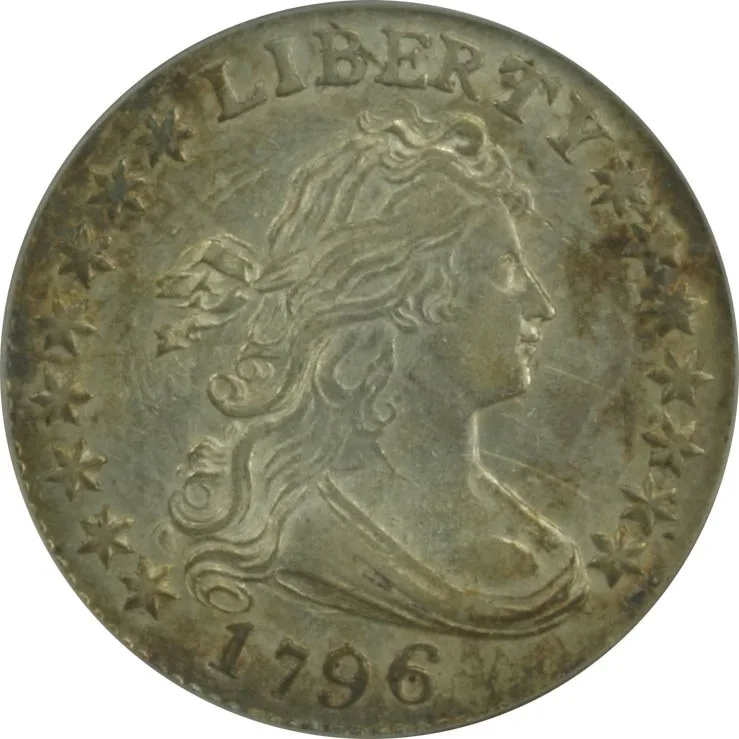
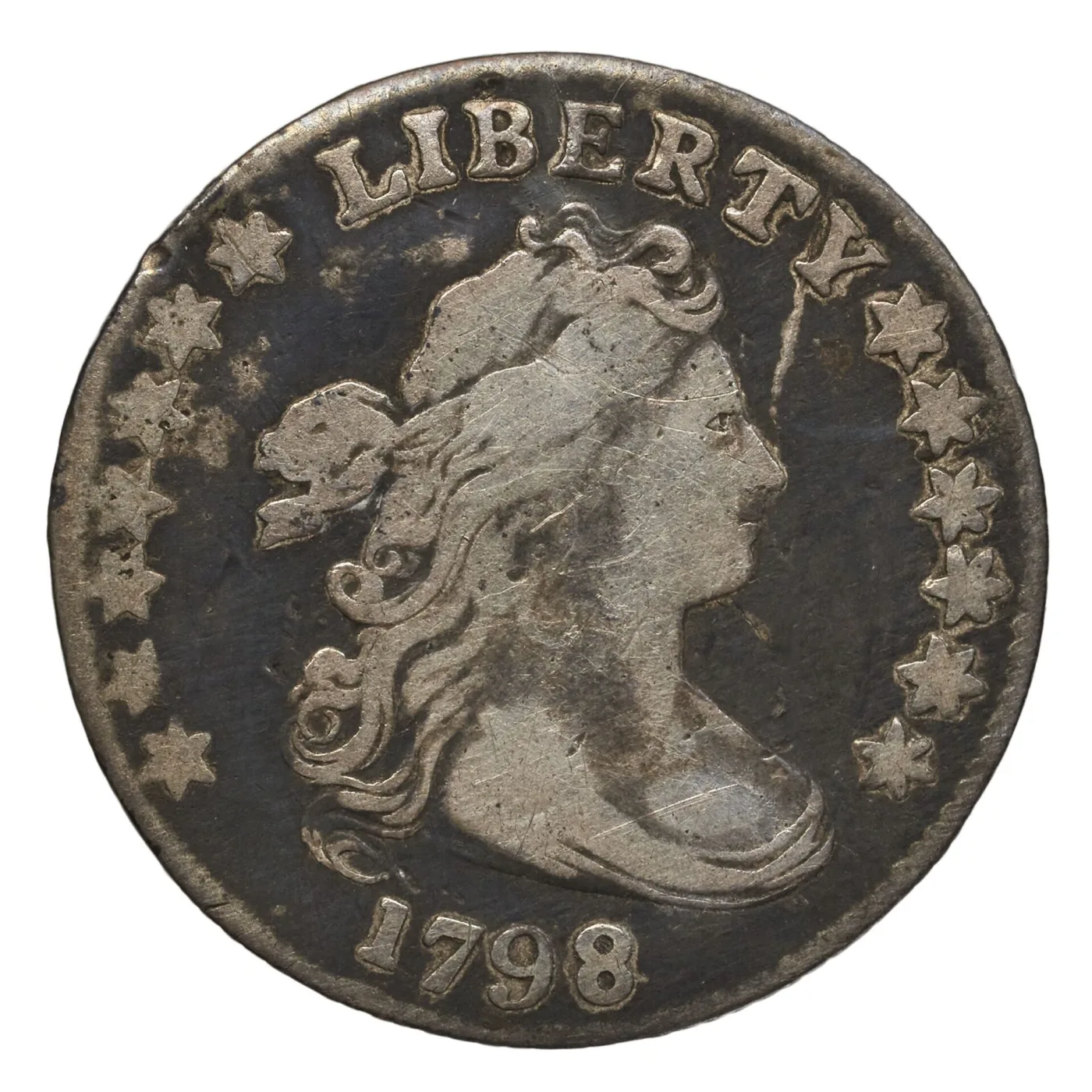
The obverse depicts Liberty facing right, her hair flowing freely and tied back with a ribbon, wearing a loosely draped gown across her bust. The word LIBERTY arcs across the top of the coin above her head. The date appears in the exergue beneath the bust truncation. Stars flank the portrait — and the number of stars is one of the most important identification details in the series, varying from 13 to 16 across different years (covered in detail below). The obverse design is identical in concept across both reverse types; only the star count and minor die details change.
Reverse (Tails Side) — Small Eagle (1796-1797)
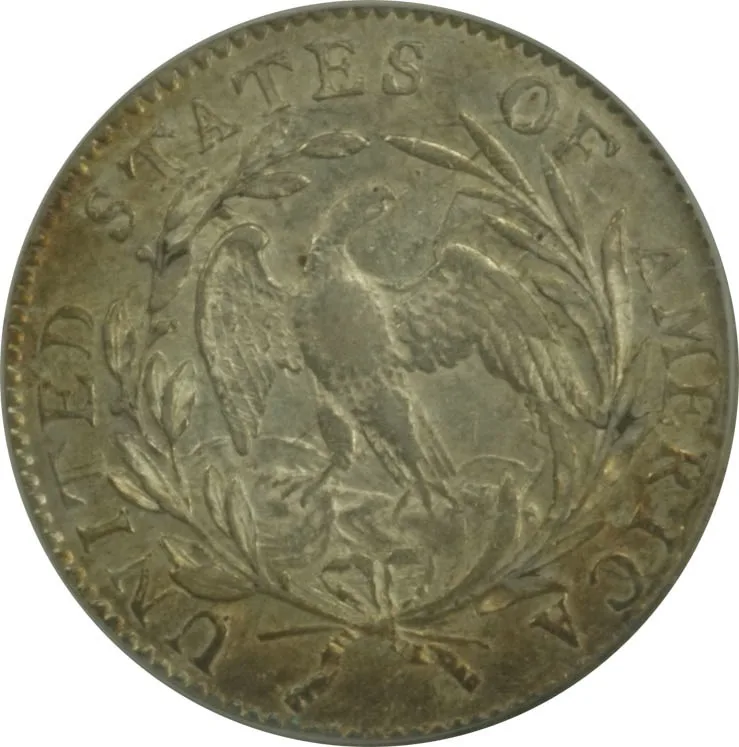
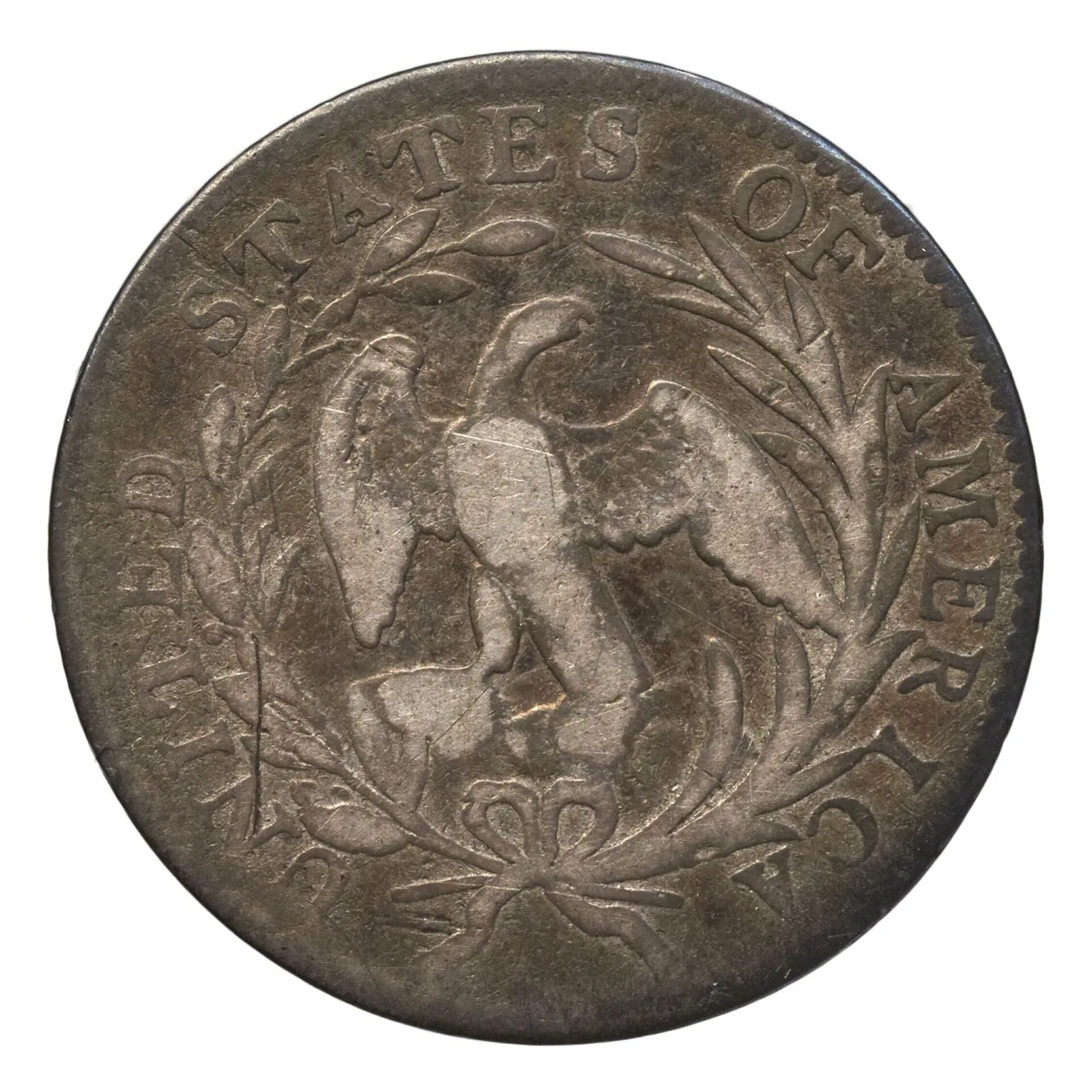
The Small Eagle reverse shows a delicate, naturalistic eagle with spread wings, perched on a cloud bank, surrounded by an open wreath of palm and olive branches. The legend UNITED STATES OF AMERICA encircles the design. There is no denomination on the reverse and no shield on the eagle’s breast — this is a “naked” eagle in heraldic terms. The Small Eagle is widely considered the more beautiful of the two reverses and is far scarcer, lasting only the 1796 and 1797 issues.
Reverse (Tails Side) — Heraldic Eagle (1798-1807)
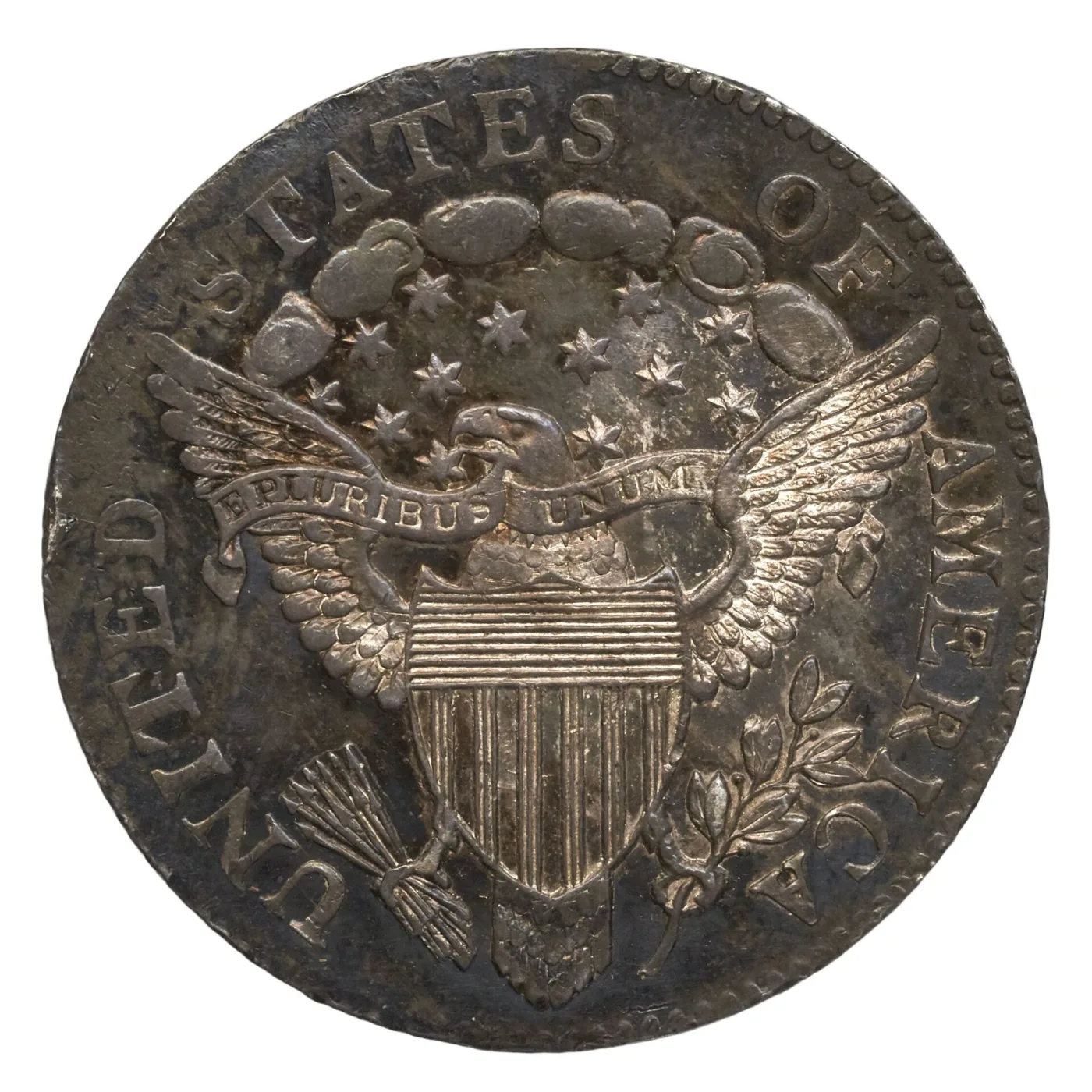
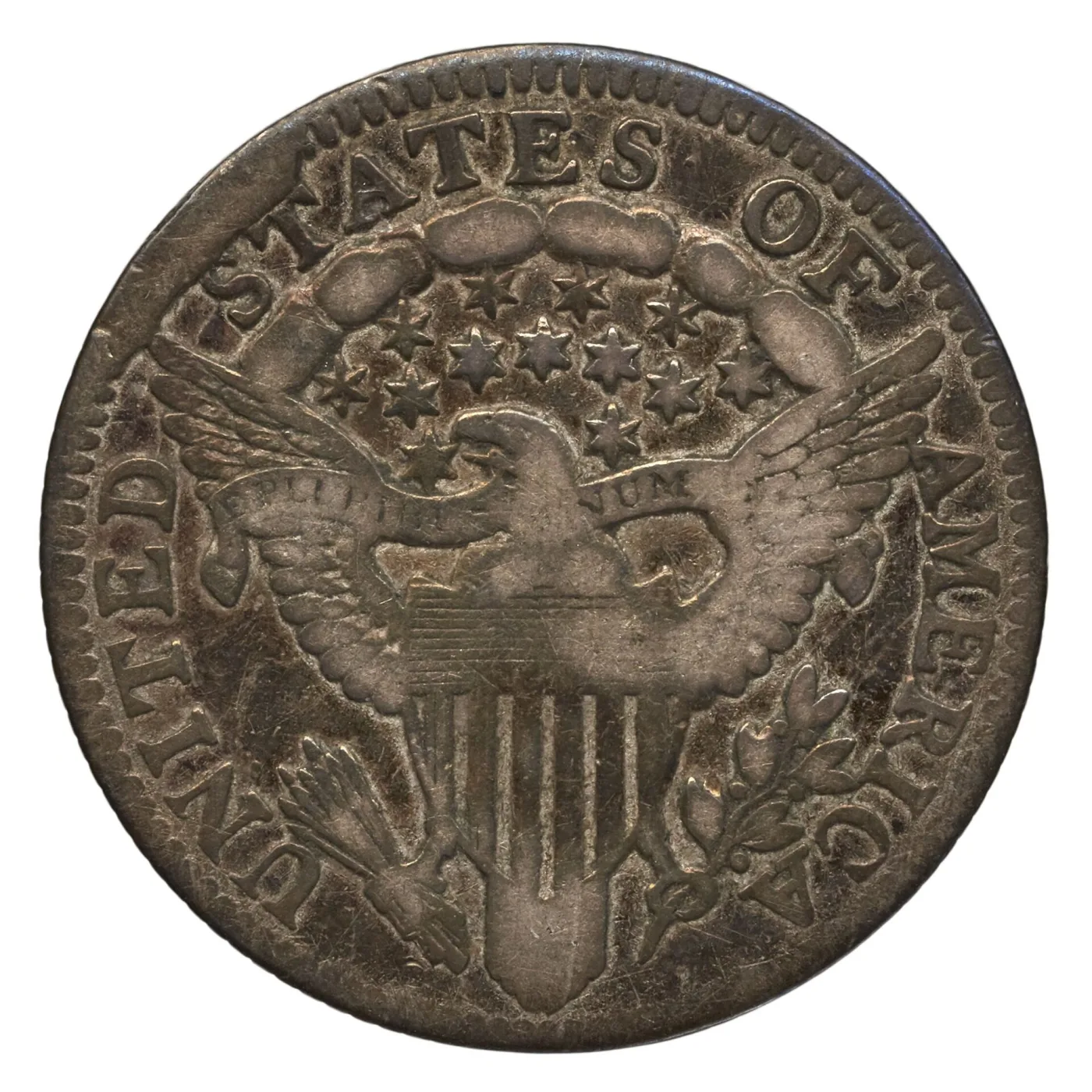
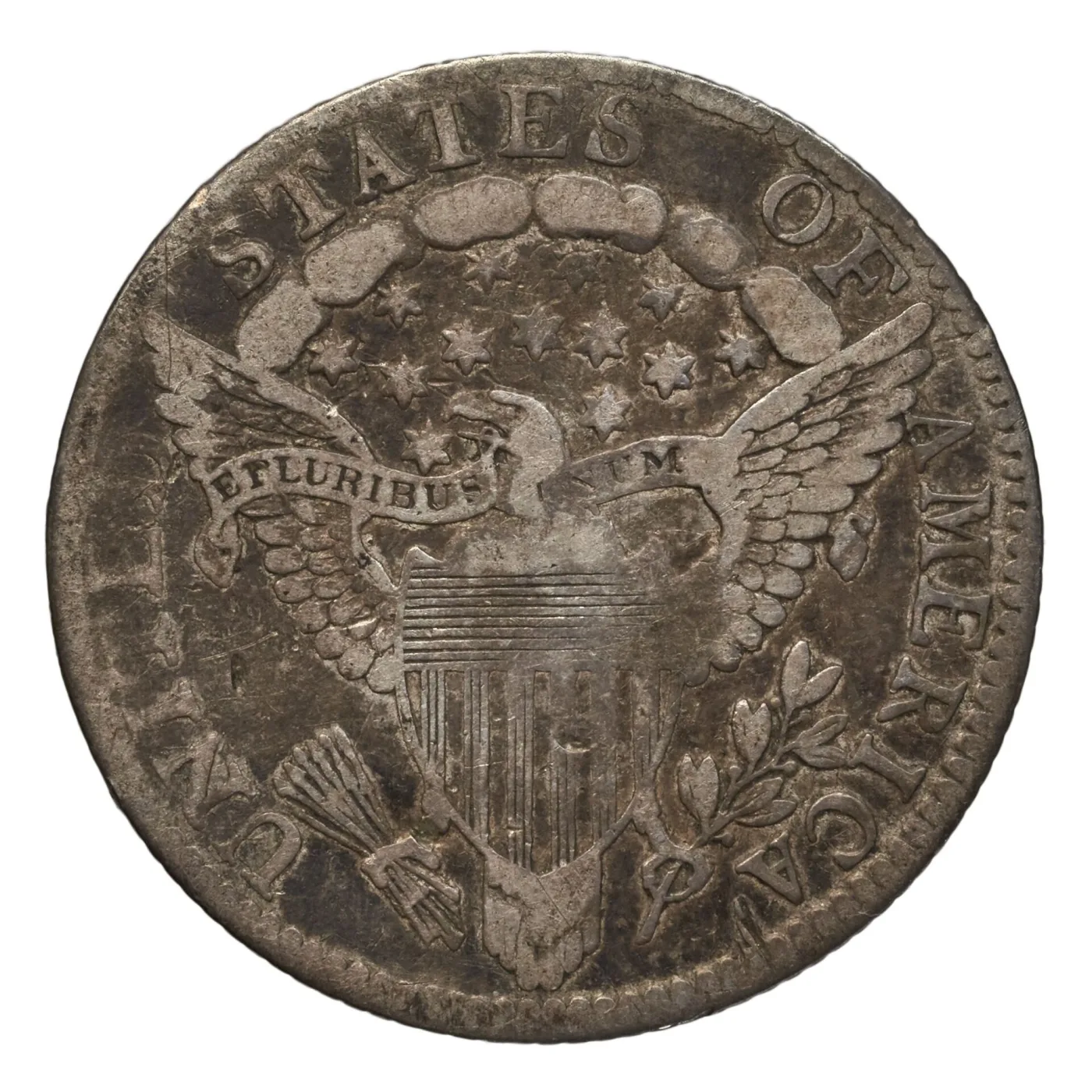
The Heraldic Eagle reverse (also called the “Large Eagle”) shows a more formal, shield-breasted eagle modeled on the Great Seal of the United States. The eagle clutches a bundle of arrows in one talon and an olive branch in the other, with a banner reading E PLURIBUS UNUM above its head and a field of stars and clouds at the top. The legend UNITED STATES OF AMERICA again encircles the design. Like the Small Eagle, this reverse carries no stated denomination — a quirk shared with several early US silver coins. The Heraldic Eagle is the reverse used for the bulk of the series, from 1798 through 1807.
Edge
All Draped Bust Dimes have a reeded edge, applied with an open collar before striking. Because there was no close collar (that technology did not reach the dime until the 1828 Small Size Capped Bust Dime), edges and diameters vary slightly from coin to coin, and the strike is often uneven from rim to center.
Designer Initials and Denomination
The Draped Bust Dime carries no designer initials and — notably — no mark of value anywhere on the coin. There is no “10 C.”, no “DIME”, and no “ONE DIME” on either type. The denomination was understood by size and weight alone. This absence is a useful authentication tool: any “Draped Bust” dime that shows a stated denomination is altered or fantasy.
Small Eagle vs Heraldic Eagle: The Critical Type Split
The single most important identification step for any Draped Bust Dime is determining whether it carries the Small Eagle reverse (1796-1797) or the Heraldic Eagle reverse (1798-1807). The two reverse types are distinct enough that most type collectors pursue one of each, and the Small Eagle commands a dramatic premium because of its two-year run and tiny surviving population.
Put the two reverses next to each other once and you will not need the test again.
Small Eagle Diagnostics (1796-1797)
Look for a small, slender eagle with naturally spread wings perched on a bank of clouds, surrounded by an open wreath. The eagle has no shield on its breast and the design has an airy, delicate appearance with significant open field around the central device. Only two dates exist: 1796 (15 stars) and 1797 (which comes in 13-star and 16-star varieties). If you see a wreath and a thin perched eagle on clouds, you have a Small Eagle — one of just two years of the type.
Heraldic Eagle Diagnostics (1798-1807)
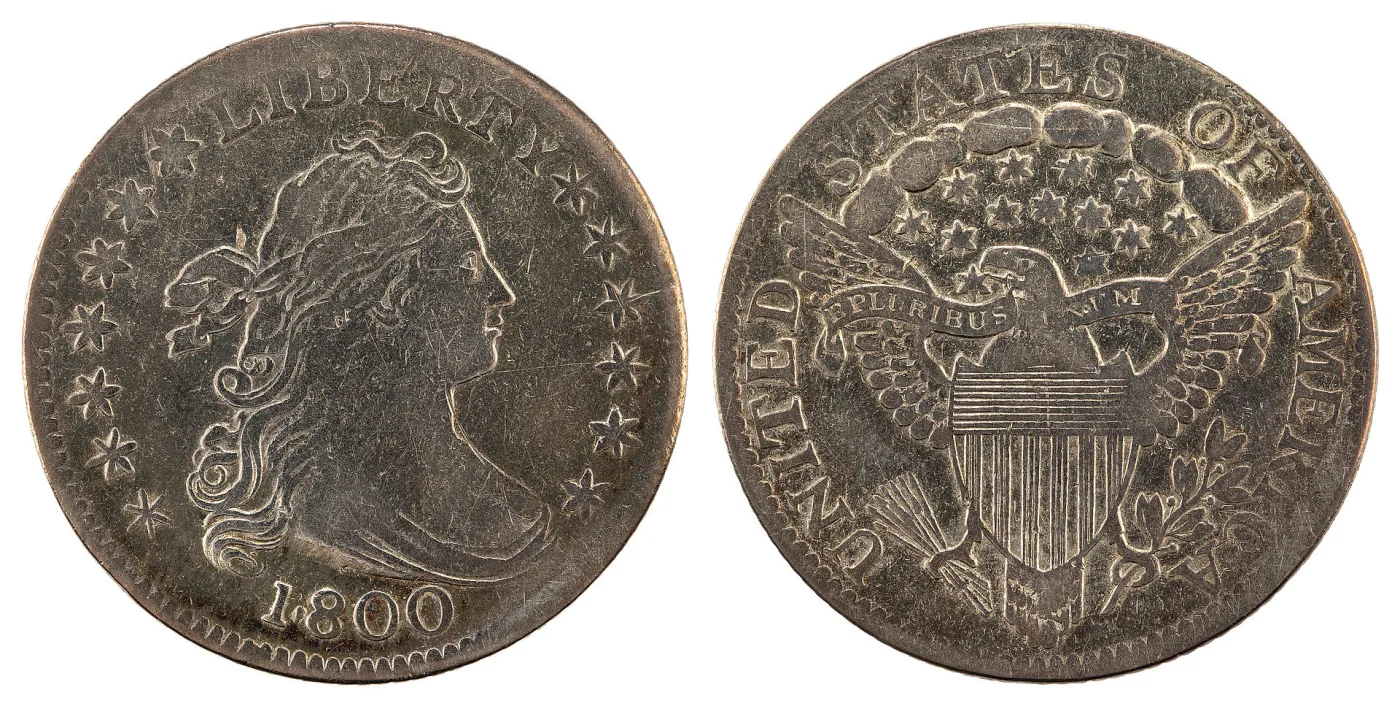
Look for a larger, heavier eagle with a striped shield on its breast, a banner reading E PLURIBUS UNUM in its beak, arrows and an olive branch in its talons, and a cluster of stars and clouds above. The design fills more of the field and has a formal, official appearance. Every date from 1798 onward uses this reverse. If you see a shield-breasted eagle with a banner, you have a Heraldic Eagle.
Why the Mint Made the Change
The Small Eagle was criticized in its day as looking weak and “more like a wild turkey or pigeon” than a majestic national bird. Beginning in 1798, Robert Scot replaced it across the silver and gold series with the Heraldic Eagle adapted from the Great Seal, which conveyed greater dignity and matched the iconography on official US documents. The same transition occurred on the half dime, quarter, and dollar at roughly the same time, so the Small Eagle reverse is scarce across all early Draped Bust denominations — see the parallel story in the Draped Bust Dollar guide.
Star Counts: 13, 15, and 16 Stars Explained
One of the most confusing — and most collectible — aspects of the Draped Bust Dime is the changing number of obverse stars. Because each die was hand-punched, the Mint experimented with star counts as new states joined the Union, then ultimately standardized on thirteen for the original colonies. Getting the star count right is essential for both attribution and valuation.
Obverse Star Counts
- 13 stars: The 1797 issue exists with 13 stars, one per original colony — the founding states.
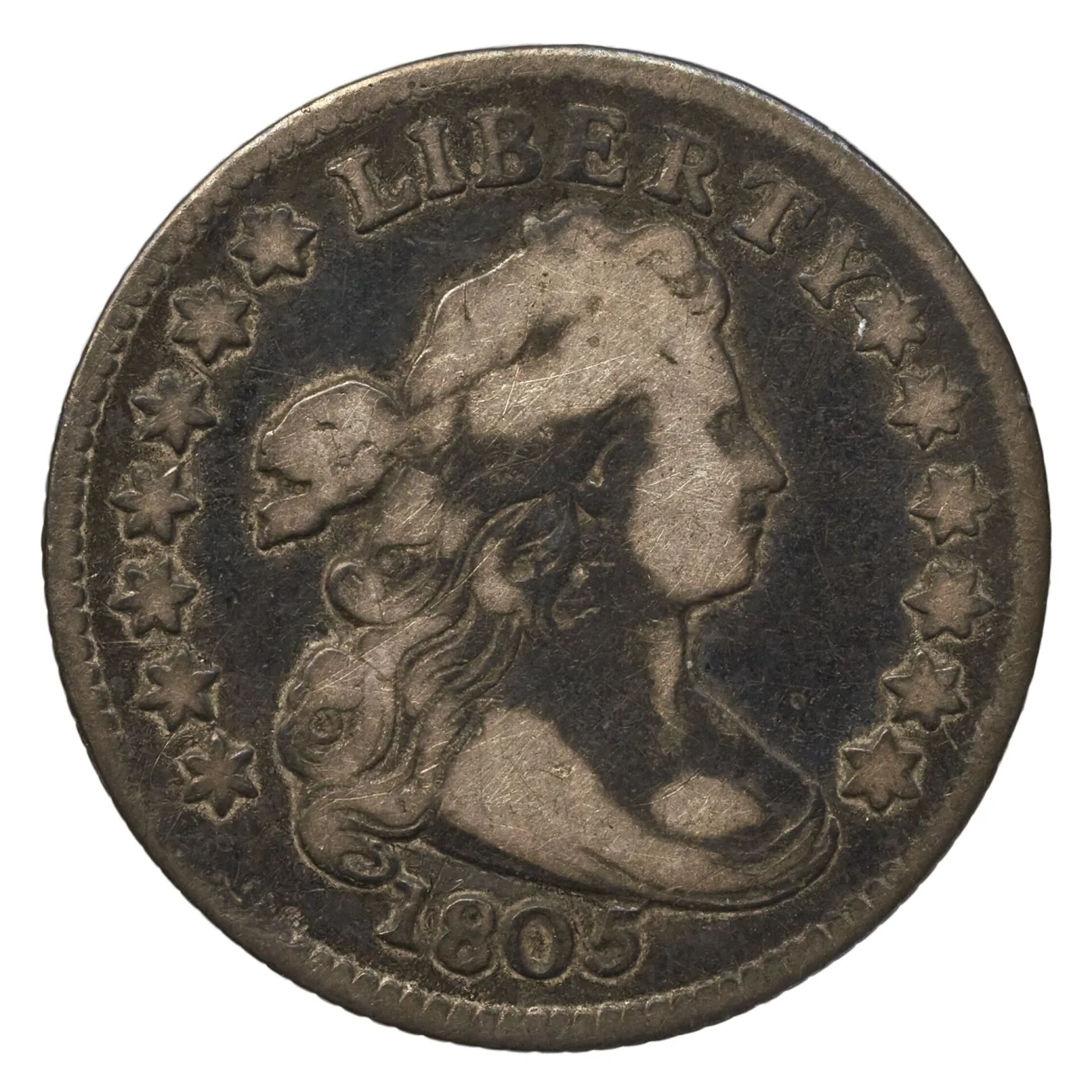
- 15 stars: Some early Draped Bust silver reflects the addition of Vermont (1791) and Kentucky (1792), bringing the count to fifteen. This is what the first-year 1796 dime carries: eight stars left of the bust and seven right, the same arrangement as the contemporary half dime and dollar. Count them before anything else — a 1796 dime showing thirteen is not a 1796 dime.
- 16 stars: The 1797 issue also exists with 16 stars, reflecting the admission of Tennessee in 1796. When the Mint realized the count would have to keep growing as new states joined, it abandoned the policy and reverted to 13 stars going forward.
Reverse Star Counts on the Heraldic Eagle
The Heraldic Eagle reverse carries a cluster of stars above the eagle, and the count of these reverse stars also varies by die — most commonly 13, but some 1798 dies show a “16-star reverse” where extra stars were punched into the cloud field. The 1798 over 97 with 16-star reverse is a recognized variety. Reverse star counts are a key diagnostic for separating the earliest Heraldic Eagle dies.
Why Star Counts Matter for Value
Star-count varieties can change a coin’s value substantially. The 1797 16-star, for example, is a distinct collectible variety priced separately from the 1797 13-star. When identifying any Draped Bust Dime, always count the obverse stars carefully (note how many are left versus right of the bust) and, on Heraldic Eagle coins, count the reverse stars too. The same star-count drama plays out on the sister Draped Bust Half Dime, where 13, 15, and 16-star varieties are all collected.
Composition and Specifications
Knowing the metal content and weight is essential for both authentication and bullion-floor valuation.
Weight and Fineness
- All Draped Bust Dimes (1796-1807): 2.70 g, approximately 19 mm diameter (nominal), 0.8924 silver / 0.1076 copper (89.24% silver, the “standard silver” specification of the 1792 Mint Act).
Note that the diameter is not perfectly consistent because the coins were struck with an open collar — measured examples typically range from about 18.8 mm to 19.0 mm. The weight standard of 2.70 g held constant across the entire series.
Silver Content
A Draped Bust Dime contains approximately 0.0774 troy ounces of pure silver. At a silver spot of $30/oz the bullion floor is about $2.32. In practice, no genuine Draped Bust Dime should ever trade anywhere near melt: the numismatic premium for every date runs from the high hundreds into many thousands of dollars, dwarfing the trivial silver value even for the most worn examples.
Weight as Authentication Tool
Use a jeweler’s scale accurate to 0.01 grams. Tolerance for genuine coins is roughly ± 0.10 g, slightly wider than later close-collar issues because of the cruder early production. Cast counterfeits often weigh significantly under standard (commonly 2.30-2.55 g) because contemporary casting alloys were lower density. Watch for “adjustment marks” — faint parallel file lines applied at the Mint to reduce overweight planchets to standard. These are normal on genuine early silver and are actually a sign of authenticity, not damage. The same authentication discipline applies across the early federal silver family — for the parallel diagnostics on dollars, see the Draped Bust Dollar guide.
Mint Marks: A Philadelphia-Only Series
Every Draped Bust Dime was struck at the Philadelphia Mint, the only US mint in operation during this period. There are no branch-mint Draped Bust Dimes — the first branch-mint US dime is the 1838-O Seated Liberty Dime from New Orleans, struck decades later.
What This Means for Identification
No Draped Bust Dime carries a mint mark. Any “Draped Bust” dime offered with an “O,” “S,” “CC,” or “D” mint mark is either a counterfeit or an altered modern fantasy. This is one of the simplest authentication tests in early American silver: if it has a mint mark, it isn’t genuine.
The Implication for Series Difficulty
Because the series is Philadelphia-only, the only attribution variables are date, reverse type (Small Eagle vs Heraldic Eagle), star count, and die variety (JR-number). This keeps a date set relatively compact (ten dates) while still offering deep specialist appeal via star-count and JR varieties. By contrast, a date-and-mint-mark set of Seated Liberty Dimes requires far more entries, including the famous Carson City keys.

The JR Variety System and Die Marriages
Like the later Capped Bust Dime, the Draped Bust Dime is attributed using the “JR” numbering system developed by the John Reich Society and published in the standard reference “Early United States Dimes 1796-1837” (Davis, Logan, Lovejoy, McCloskey, and Subjack, 1984). Because every die was hand-engraved with individually positioned stars, dates, and devices, each obverse-reverse pairing produces distinct micro-diagnostics.
How JR Numbers Work
Each unique obverse-reverse die marriage receives a “JR” number per date — for example, 1805 JR-1, 1805 JR-2, and so on. The numbers are assigned in approximate order of rarity, with low numbers being more common. A given date can have anywhere from a single JR variety to several. Attribution requires matching specific obverse die diagnostics (star positions, date placement, die cracks) with reverse die diagnostics (eagle and shield details, cloud and star arrangement, denticle alignment). Older references and auction catalogs sometimes use the related “Valentine” (V-numbers) or “LM” (Logan-McCloskey) numbering systems for early dimes; modern attribution favors the JR system.
Why It Matters
JR and star-count variety attribution can multiply the value of an otherwise common-date coin. Because the series is so scarce overall, even modest varieties trade at strong premiums, and the rarest die marriages — some known from only a handful of examples — bring spectacular prices. Type collectors are happy with any JR variety of each reverse type; specialists pursue every documented die marriage. The reference book is the practical tool for serious attribution.
Notable JR Varieties
- 1796 JR-1 to JR-6: Six die marriages exist for the first-year 1796, all with 15 stars and the Small Eagle reverse.
- 1797 JR-1 (16 stars) and JR-2 (13 stars): The two 1797 varieties, distinguished by obverse star count.
- 1798/97 JR-1 (16-star reverse) and JR-2 (13-star reverse): The 1798 over 1797 overdate, with two reverse star configurations.
- 1798 Small 8 / Large 8: Two distinct date-punch sizes for the non-overdate 1798.
- 1800 JR-1, JR-2: Die marriages for the 1800 issue.
- 1804 13 Stars / 14 Stars (reverse): The rare 1804 exists with both 13-star and 14-star reverse dies; the 14-star reverse is especially prized.
- 1805 4 Berries / 5 Berries: Two reverse varieties distinguished by the number of berries in the olive branch.
The same depth of hand-engraved die-variety collecting exists across early American copper and silver — see the Large Cent guide for the parallel Sheldon and Newcomb systems.
Key Dates and Major Rarities
Across just ten production years, several Draped Bust Dime dates and varieties stand out as major rarities. Because the entire series is scarce, even “common” dates are valuable — but these keys define the series economy and attract the most counterfeits and altered coins.
The Series Keys
- 1796 (first year, Small Eagle, 15 stars): The first US dime and a one-year design pairing. Mintage about 22,135. A premier type coin. G-4 ~$3,000, F-12 ~$6,000, XF ~$15,000+, MS ~$60,000+. Heavily sought and frequently counterfeited.
- 1797 16 Stars (Small Eagle): The scarcer of the two 1797 varieties. G-4 ~$3,000, F-12 ~$6,500, XF ~$16,000+.
- 1797 13 Stars (Small Eagle): Also rare. G-4 ~$3,200, F-12 ~$7,000, XF ~$17,000+.
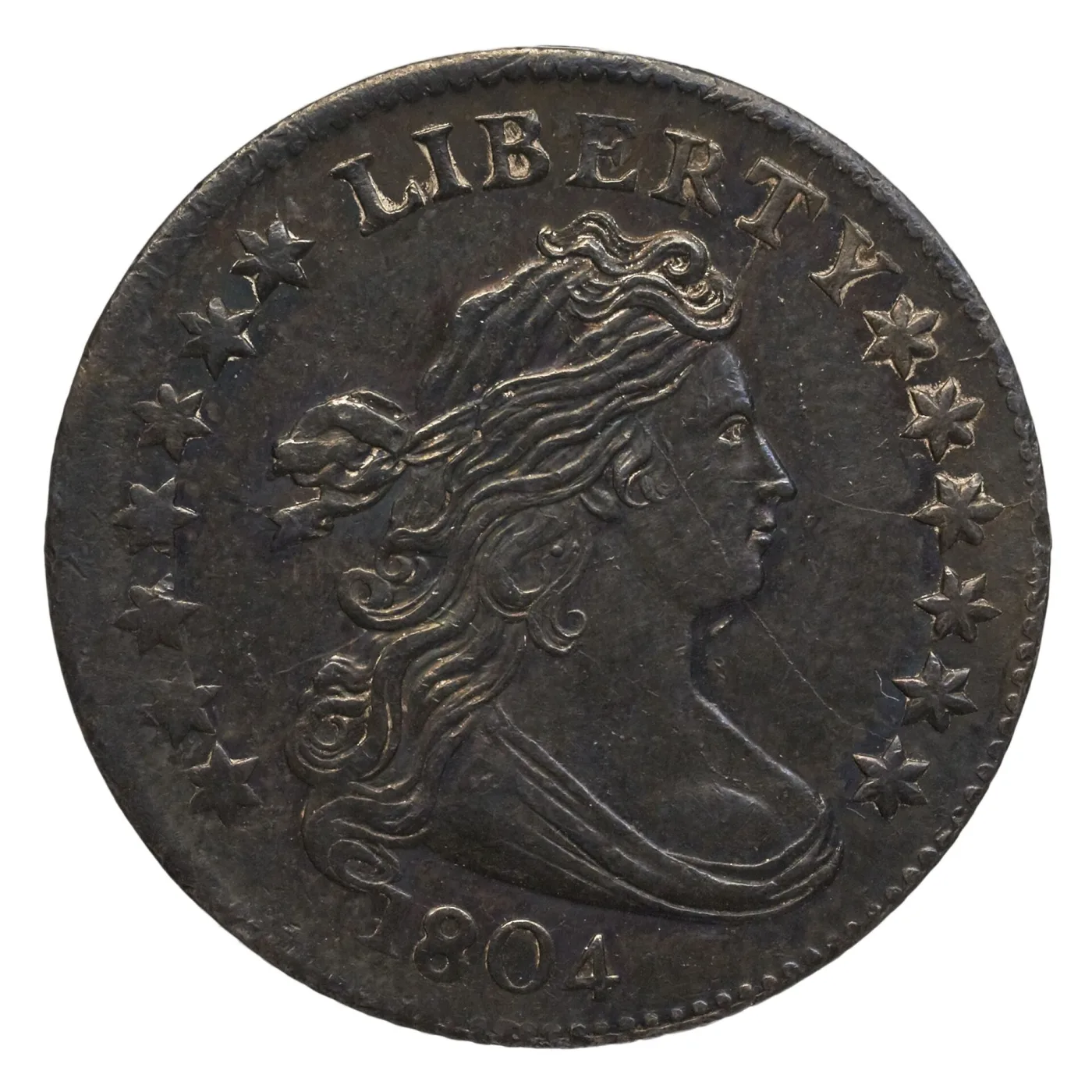
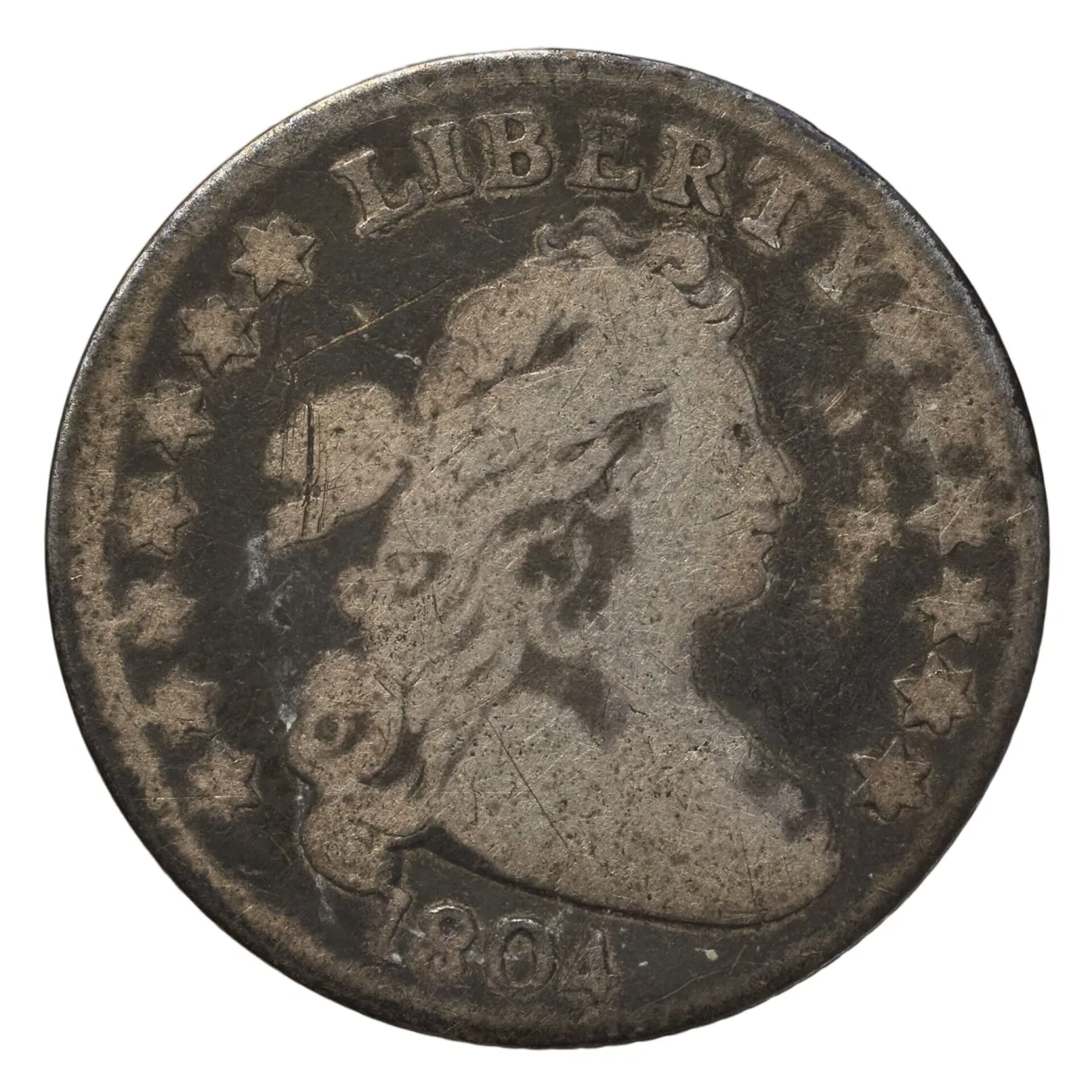
- 1804 13 Stars (Heraldic Eagle): One of the rarest dates in the series, with a tiny mintage (about 8,265 for the year). G-4 ~$3,500, F-12 ~$9,000, XF ~$30,000+.
- 1804 14 Stars (Heraldic Eagle reverse): The 14-star reverse variety is rarer still and brings strong premiums over the 13-star.
- 1798/97 16-Star Reverse: The dramatic first-year Heraldic Eagle overdate. G-4 ~$900, F-12 ~$2,000, XF ~$6,000+.
The 1804 is the date most worth recognising on sight, and most worth seeing at two levels of wear.
Better Dates and More Available Years
- 1798 Large 8 / Small 8: The non-overdate 1798 dates. F-12 ~$700, XF ~$2,500.
- 1800: Mintage about 21,760. F-12 ~$700, XF ~$2,500.
- 1801: Mintage about 34,640. F-12 ~$750, XF ~$2,800.
- 1802: Mintage about 10,975 — a scarcer date. F-12 ~$900, XF ~$3,500.
- 1803: Mintage about 33,040. F-12 ~$750, XF ~$2,800.
- 1805 (4 Berries / 5 Berries): The most available date, the easiest type coin. F-12 ~$500, XF ~$1,400, MS ~$8,000.
- 1807: The final year and second-most available. F-12 ~$500, XF ~$1,400, MS ~$8,000.
Condition Rarities
Even among the more available 1805 and 1807 dates, Mint State examples are genuinely rare because virtually all Draped Bust Dimes circulated heavily for decades. A common 1807 that brings $500 in F-12 might bring $8,000 in MS-63 and $25,000+ in MS-65. Gem examples (MS-65 and finer) of any date are major condition rarities, and the finest-known examples of the keys bring six-figure prices at auction.
Overdates and Date Varieties
Because dies were sometimes carried over from year to year and dates were hand-punched, overdates and date-punch varieties appear throughout the series. These are some of the most collectible issues.
1798/97 (Ninety-Eight Over Ninety-Seven)
The first Heraldic Eagle dimes of 1798 were struck partly from dies recut from 1797. Under magnification, the underlying “7” is visible beneath the “8” of the date. The 1798/97 comes with both a 16-star reverse and a 13-star reverse, making it two collectible varieties. This overdate is the headline variety of the early Heraldic Eagle dimes.
1798 Large 8 vs Small 8
The non-overdate 1798 issues used two different “8” punches in the date — a larger 8 and a smaller 8. Distinguishing them requires comparing the size and shape of the final digit. Both are collected as distinct varieties.
1804 13-Star vs 14-Star Reverse
The rare 1804 exists with two reverse dies: one with the standard 13 stars above the eagle and one with 14 stars (an extra star punched into the cloud field). The 14-star reverse is the rarer and more valuable of the two. Because 1804 is already a key date, both varieties command premium prices, and attribution should be confirmed by a specialist.
1805 4 Berries vs 5 Berries
The 1805 reverse comes with either four or five berries in the olive branch held by the eagle. The “4 Berries” and “5 Berries” varieties are distinguished by careful examination of the branch. Because 1805 is the most available date, these varieties are an accessible entry point into Draped Bust Dime variety collecting.
The Missing Years and Production Gaps
The Draped Bust Dime has two “no-issue” years and an abrupt reverse change that confuse newcomers. Understanding these gaps prevents wasted searches for coins that never existed.
No 1799 and No 1806 Dimes
The Philadelphia Mint struck no dimes dated 1799 or 1806. In those years the Mint prioritized other denominations, or bullion depositors requested larger coins. Any “1799” or “1806” Draped Bust Dime is therefore a fantasy, an altered date, or a contemporary counterfeit. This is a useful authentication checkpoint: the date itself can disqualify a coin.
The 1797-1798 Reverse Transition
There is no 1798 Small Eagle dime and no 1797 Heraldic Eagle dime. The reverse changed cleanly between the 1797 and 1798 production runs. If you encounter a 1797 with a Heraldic (shield-breasted) eagle, or a 1798 with a Small Eagle on clouds, the coin is mismatched and almost certainly altered or counterfeit.
This is what a genuine 1798 looks like from both sides.
Why the Gaps Happened
Early Mint production was driven by bullion deposits from banks and merchants, who often preferred their silver returned as larger, more convenient coins. The Mint also struggled with equipment failures, yellow-fever epidemics that shut down Philadelphia, and chronic shortages of skilled labor. The result is the irregular date pattern seen across all early federal silver, including the sister Draped Bust Quarter, which has even larger gaps in its own production.
Grading Draped Bust Dimes
Draped Bust Dime grading follows the Sheldon 70-point scale, with several diagnostic wear points particular to the series. Accurate grading is critical because price-grade curves are steep — and because so many surviving coins have problems that affect value more than wear does.
Key Wear Points
On the obverse, the earliest wear shows on the high points of Liberty’s hair above the forehead and on the shoulder and bust line of the drapery. On the Small Eagle reverse, wear shows first on the eagle’s breast and wing tops. On the Heraldic Eagle reverse, the eagle’s head, the tops of the wings, and the shield lines smooth first. The drapery folds across the bust are a reliable indicator: crisp folds suggest higher grades, while a smooth bust indicates heavy wear.
Grade Definitions
- About Good (AG-3): Date and major outlines visible, but most detail worn flat. Rim may merge with the field in places.
- Good (G-4 to G-6): Full date and legends readable, bust and eagle outlines complete, but little internal detail.
- Very Good (VG-8 to VG-10): All major design features visible. Some hair and drapery detail begins to show.
- Fine (F-12 to F-15): Hair and drapery show moderate detail. Eagle feathers begin to separate in protected areas.
- Very Fine (VF-20 to VF-35): Most hair curls and drapery folds distinct. Eagle shows clear feather detail.
- Extremely Fine (XF-40 to XF-45): Light wear on the highest points only. Nearly all detail sharp. Traces of mint luster may survive.
- About Uncirculated (AU-50 to AU-58): Only a trace of wear on the highest points. Significant mint luster.
- Mint State (MS-60 to MS-70): No wear. Graded on strike, surface preservation, and luster.
Strike Quality and Adjustment Marks
Draped Bust Dimes are notorious for weak strikes, especially at the centers and on the stars, because of the crude early presses and open-collar striking. A weakly-struck coin can look more worn than it is. Adjustment marks (parallel file lines on the planchet) are common and are not considered damage — though heavy adjustment marks across the focal areas can reduce eye appeal and value. Always distinguish honest wear from original strike weakness and from as-made planchet flaws when grading.
Authentication and Spotting Counterfeits
Because Draped Bust Dimes are valuable and old, they have been counterfeited in three eras: contemporary circulation counterfeits, 20th-century coin-show fakes, and modern deceptive struck counterfeits. The 1796 first year and the rare 1804 are the most-faked issues.
Weight and Specific Gravity
Standard weight is 2.70 g ± 0.10 g. Specific gravity for the 89.24% silver alloy is approximately 10.34. Cast lead-tin counterfeits typically test at 9.5 or below, and modern copper-core silver-plated fakes around 8.5-9.0. A jeweler’s scale and a precision specific-gravity test are the most reliable starting tools, especially for raw (uncertified) coins.
Date Alteration
The most common alteration is changing a more available date into a key — for example, re-engraving an 1805 or 1807 into an 1804, or fabricating a nonexistent 1799 or 1806. Look for tooling marks around the digits, disturbed metal in the surrounding field, and date spacing that does not match known genuine dies. Because there are no genuine 1799 or 1806 dimes, those dates are automatic red flags.
Mint Mark Additions
Any Draped Bust Dime with a mint mark is fake. The Philadelphia Mint did not strike mint-marked dimes until 1838-O. A “Draped Bust” dime with an “O” or “S” mint mark is a contemporary forgery, a modern fantasy, or an altered later coin.
Surface and Design Diagnostics
Genuine Draped Bust Dimes show open-collar striking characteristics: slightly uneven rims, variable diameter, occasional adjustment marks, and the soft, hand-engraved look of period dies. Cast counterfeits show pebbly surfaces, soft details, and seam lines or tool marks at the rim. Modern struck counterfeits are often too sharp and uniform, with denticles or lettering that are subtly wrong compared to genuine die diagnostics. Confirming the JR die marriage against the reference is the gold standard for authentication. The same counterfeit-detection discipline applies across early federal silver — see the Flowing Hair Dollar guide for related methods.
Third-Party Grading
For any Draped Bust Dime — and certainly for any 1796, 1797, 1804, or Mint State example — third-party authentication through PCGS or NGC is strongly recommended. Given the prices these coins command, the cost of certification is trivial compared to the risk of buying a fake. JR variety attribution is available as an add-on service and is worth obtaining for scarce die marriages.
Current Market Values and Price Guide
Values below are approximate retail for problem-free, original coins as of 2026. Auction results, cleaned and problem coins, and exceptional specimens vary widely. Star-count and JR variety attribution can shift these numbers significantly.
Small Eagle Type (1796-1797)
- 1796 (15 stars): G-4 ~$3,000, F-12 ~$6,000, XF-40 ~$15,000, MS-63 ~$60,000+.
- 1797 16 Stars: G-4 ~$3,000, F-12 ~$6,500, XF-40 ~$16,000.
- 1797 13 Stars: G-4 ~$3,200, F-12 ~$7,000, XF-40 ~$17,000.
Heraldic Eagle Type (1798-1807)
- 1798/97 16-Star Reverse: G-4 ~$500, F-12 ~$2,000, XF-40 ~$6,000.
- 1798 Large 8 / Small 8: G-4 ~$350, F-12 ~$700, XF-40 ~$2,500.
- 1800: G-4 ~$350, F-12 ~$700, XF-40 ~$2,500.
- 1801: G-4 ~$375, F-12 ~$750, XF-40 ~$2,800.
- 1802: G-4 ~$450, F-12 ~$900, XF-40 ~$3,500.
- 1803: G-4 ~$375, F-12 ~$750, XF-40 ~$2,800.
- 1804 13 Stars: G-4 ~$3,500, F-12 ~$9,000, XF-40 ~$30,000+.
- 1805 (most available): G-4 ~$250, F-12 ~$500, XF-40 ~$1,400, MS-63 ~$8,000.
- 1807: G-4 ~$250, F-12 ~$500, XF-40 ~$1,400, MS-63 ~$8,000.
Pricing Resources
For current market data, consult the PCGS Price Guide, NGC Price Guide, and recent auction archives at Heritage Auctions, Stack’s Bowers, and Great Collections. The “Greysheet” (Coin Dealer Newsletter) provides wholesale bid/ask pricing updated weekly. For JR-variety-specific results, the John Reich Journal publishes specialist auction data not captured in general price guides. Because the series is thinly traded, recent auction comparables are often the most accurate guide to true market value.
Building a Draped Bust Dime Collection
Draped Bust Dimes can be collected at several levels of depth and budget, though every level requires a meaningful investment because the series is scarce throughout.
Type Set (2 Coins)
The most popular approach: one Small Eagle and one Heraldic Eagle. The Heraldic Eagle slot is easily filled with an affordable 1805 or 1807; the Small Eagle slot requires a 1796 or 1797 and is far more expensive. Budget for a matched VF pair: roughly $7,000-$10,000, the great majority of which goes to the Small Eagle. This two-coin set captures both reverse types and serves as the foundational early dime in any US type collection.
Date Set (10 Dates)
One example of each issued year: 1796, 1797, 1798, 1800, 1801, 1802, 1803, 1804, 1805, 1807. Total budget for a G-VG set including the keys: approximately $15,000-$25,000, with the 1796, 1797, and 1804 dominating the cost. A genuinely challenging and rewarding set that few collectors complete.
Type + Variety Set (Specialist)
Add the major varieties: 1797 13-star and 16-star, 1798/97 with both reverses, 1798 Large 8 and Small 8, 1804 13-star and 14-star, 1805 4 Berries and 5 Berries. This deepens the collection considerably and pushes the budget well into five or six figures depending on grade. The John Reich Society is essential for serious variety collectors. The same kind of specialist die-marriage collecting exists in the parallel Capped Bust Dime series.
Single Showpiece
Many collectors simply acquire one outstanding example — most often a 1796 first-year dime — as a centerpiece for a type set or a “first US coinage” display. A single high-grade 1796 is a blue-chip numismatic asset with strong long-term demand.
Cleaning, Toning, and Preservation
Draped Bust Dimes are well over 200 years old. Most have circulated extensively and many have been cleaned, polished, or repaired at some point. Knowing what to look for protects a significant investment.
Original Surfaces
An original Draped Bust Dime shows soft, even toning (typically gray, gold, or russet) and undisturbed patina in the protected areas around the devices and lettering. On the rare Mint State pieces, original cartwheel luster should roll across the fields. Adjustment marks and minor planchet flaws are expected as-made characteristics. The fields should never look brilliantly bright on a circulated coin — bright, “white” surfaces signal cleaning.
Signs of Cleaning and Problems
Look for: unnaturally bright fields, fine concentric hairlines (wheel polishing), random hairlines (rag wiping), a dull frosty texture (acid dip), and “milky” residue in protected areas (incomplete rinsing). Also watch for repairs common on rare early coins — smoothed fields, tooled hair detail, plugged holes, and rim filing. Cleaned or repaired Draped Bust Dimes typically bring 30-60% of problem-free pricing, and the discount grows with the severity of the problem.
Storage Recommendations
Store Draped Bust Dimes in inert holders: PCGS or NGC slabs for certified coins, or Mylar 2x2 flips and Saflips for raw coins. Avoid soft PVC-containing flips, which leach acids that damage silver over time. Keep storage cool and dry (under 50% relative humidity). Never clean a Draped Bust Dime, no matter how dark it looks — cleaning destroys value irreversibly, and on a coin this valuable the loss can be thousands of dollars. If conservation is truly warranted, send it to NCS (NGC’s conservation service) or PCGS Restoration rather than attempting home methods. For general preservation principles across all early silver, see the broader Complete Coin Identification Guide.
Frequently Asked Questions
What is the rarest Draped Bust Dime?
The 1804 is generally considered the rarest regular date, with a tiny mintage (about 8,265 for the year) and very few survivors, especially in the 14-star reverse variety. The 1796 first year and both 1797 varieties are also major rarities and, as the only Small Eagle dimes, are intensely sought by type collectors. Among varieties, the 1804 14-star reverse is one of the toughest of all.
How do I tell the Small Eagle from the Heraldic Eagle?
Look at the reverse. The Small Eagle (1796-1797) is a thin, naturalistic eagle perched on clouds inside an open wreath, with no shield. The Heraldic Eagle (1798-1807) is a heavier, shield-breasted eagle with a banner reading E PLURIBUS UNUM and a cluster of stars and clouds above. If you see a wreath, it's a Small Eagle; if you see a shield and banner, it's a Heraldic Eagle.
Why are there no 1799 or 1806 Draped Bust Dimes?
The Philadelphia Mint simply did not strike dimes in those two years, prioritizing other denominations and responding to bullion depositors who preferred larger coins. Any 1799 or 1806 "Draped Bust Dime" is a fantasy, an altered date, or a counterfeit.
Does the Draped Bust Dime have a mint mark?
No. Every Draped Bust Dime was struck at Philadelphia, which used no mint mark. Any example with a mint mark is fake. The first branch-mint US dime is the 1838-O Seated Liberty Dime.
Why doesn't the coin say "10 cents" or "dime" anywhere?
Early US silver coins, including the Draped Bust Dime, carried no stated denomination — the value was understood by the coin's size and weight. The dime did not gain a stated denomination until the "10 C." appeared on the later Capped Bust Dime reverse. Any Draped Bust dime showing a denomination is altered or fantasy.
How much is a typical Draped Bust Dime worth?
Even the most available dates (1805 and 1807) start around $250 in G-4 and $500 in F-12, rising to $1,400 in XF and $8,000+ in MS-63. The keys are far higher: a 1796 brings about $3,000 in G-4 and $60,000+ in Mint State. Because the series is scarce throughout, always confirm date, reverse type, and star count before pricing.
Should I clean my Draped Bust Dime?
Absolutely not. Cleaning destroys 30-60% of value irreversibly, and on a coin worth thousands of dollars that is a serious loss. Even "gentle" methods leave detectable evidence. If a coin genuinely needs conservation, send it to NCS or PCGS Restoration — never attempt home cleaning.
Where can I sell my Draped Bust Dime?
Because these coins are valuable and thinly traded, the best results almost always come from major auction houses — Heritage Auctions, Stack's Bowers, or Great Collections — where the specialist buyer base competes for early type coins. Always have the coin authenticated and graded by PCGS or NGC before selling; certification both protects the buyer and maximizes your price.
How does the Draped Bust Dime compare to the Capped Bust Dime?
The Draped Bust Dime (1796-1807) is the earlier, scarcer series with Robert Scot's flowing-hair Liberty and no stated denomination. The Capped Bust Dime (1809-1837) is the larger, more affordable successor with John Reich's capped Liberty and a "10 C." denomination on the reverse. Both are 89.24% silver. Draped Bust Dimes are rarer and more expensive across the board; Capped Bust Dimes offer a deeper, more affordable date and JR-variety scene.