Shield Nickel: Rays or No Rays?
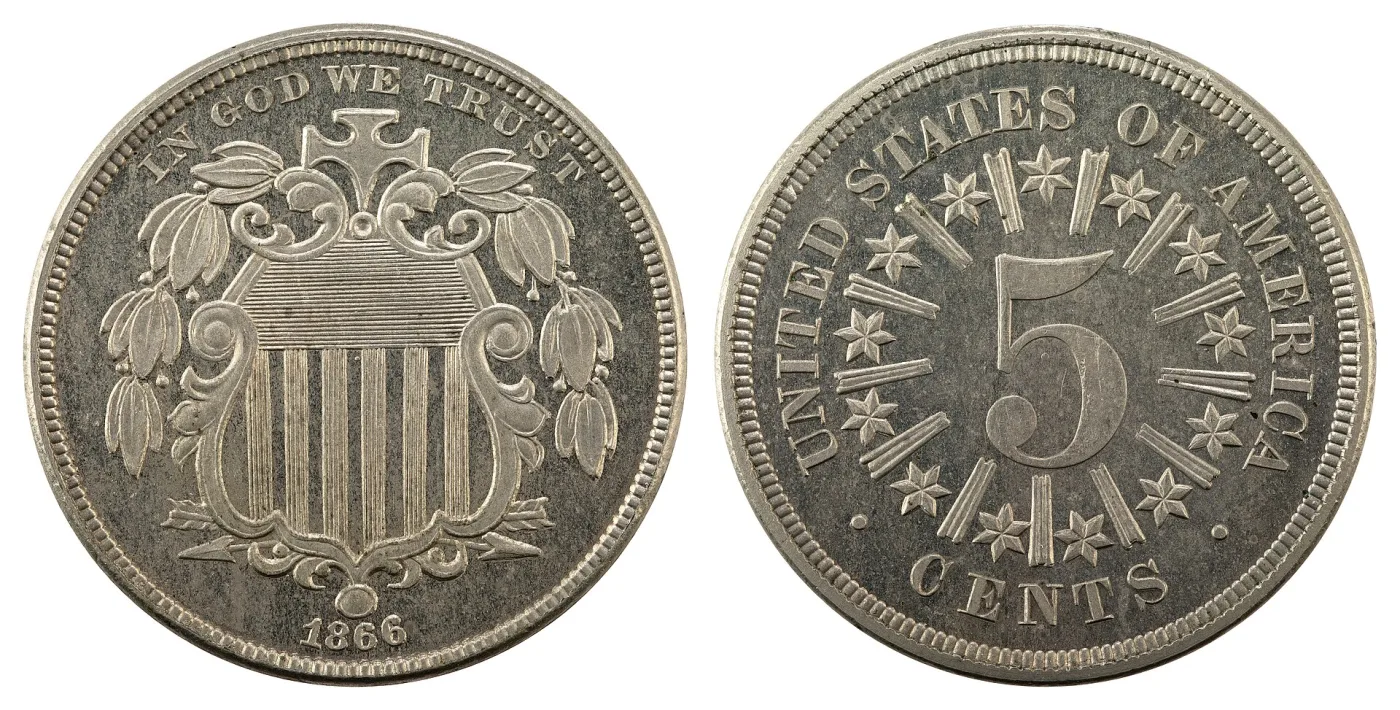
A Shield nickel dated 1866 has rays on the reverse. One dated 1868 or later does not. Every date in the series answers itself that way except one: 1867 exists both ways, and the two are not worth the same money.
Telling them apart takes one glance at the back of the coin and no equipment at all. The Mint stopped striking the rays about five weeks into 1867, which is why one of the two 1867s outnumbers the other more than fourteen to one.
Why Only 1867 Exists Both Ways
The Act of 16 May 1866 authorised the first United States five-cent piece struck in copper-nickel: 75% copper to 25% nickel, 5.00 grams, 20.5 mm across. James B. Longacre gave it a Union shield lifted almost directly from his two cent piece of 1864, and a reverse with a large numeral 5 ringed by thirteen stars, a group of three short bars radiating outward in each gap between them.
That reverse was a manufacturing problem from the first month. The alloy is hard, the bars sat in narrow recesses cut into the die, and the pressure needed to push metal into them cracked dies early while still leaving coins softly struck. Reports reached Washington, and on 21 January 1867 Treasury Secretary Hugh McCulloch ordered the rays removed. Production stopped while new dies were prepared and restarted with the plain reverse on 1 February 1867.
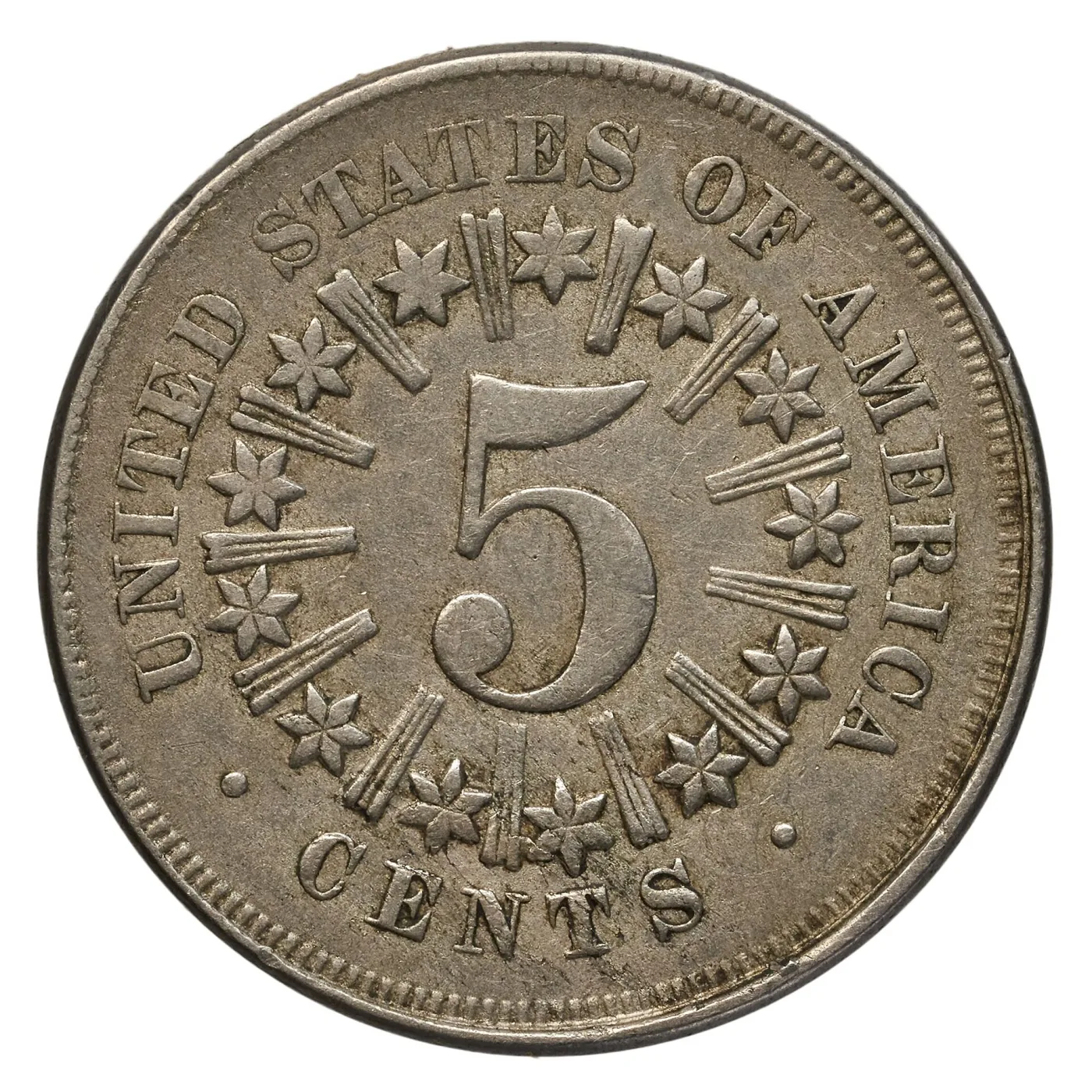
Two details are worth keeping straight, because most short accounts flatten them. First, the changeover was a schedule rather than a switch: the Mint appears to have used up the old dies it already had, so “struck before February” is an approximation. Second, removing the rays did not fix what it was meant to fix. Metal flow improved and No Rays coins are generally better struck, but the specialist literature on the series is clear that die life did not meaningfully improve, and heavy die cracks stayed routine for the next sixteen years.
A rival explanation circulates in the hobby: that the stars-and-bars reverse read as Confederate imagery to a public three years out of the Civil War. Critics really were unkind. Joseph Wharton, the nickel magnate whose lobbying produced the denomination, thought it suggested a tombstone under weeping willows. But the order McCulloch signed was a production decision, and the aesthetic complaints are the weather around it rather than the cause.
The Test: Look Between the Stars
Ignore the shield side entirely. Turn the coin over and look at the thirteen gaps between the stars.
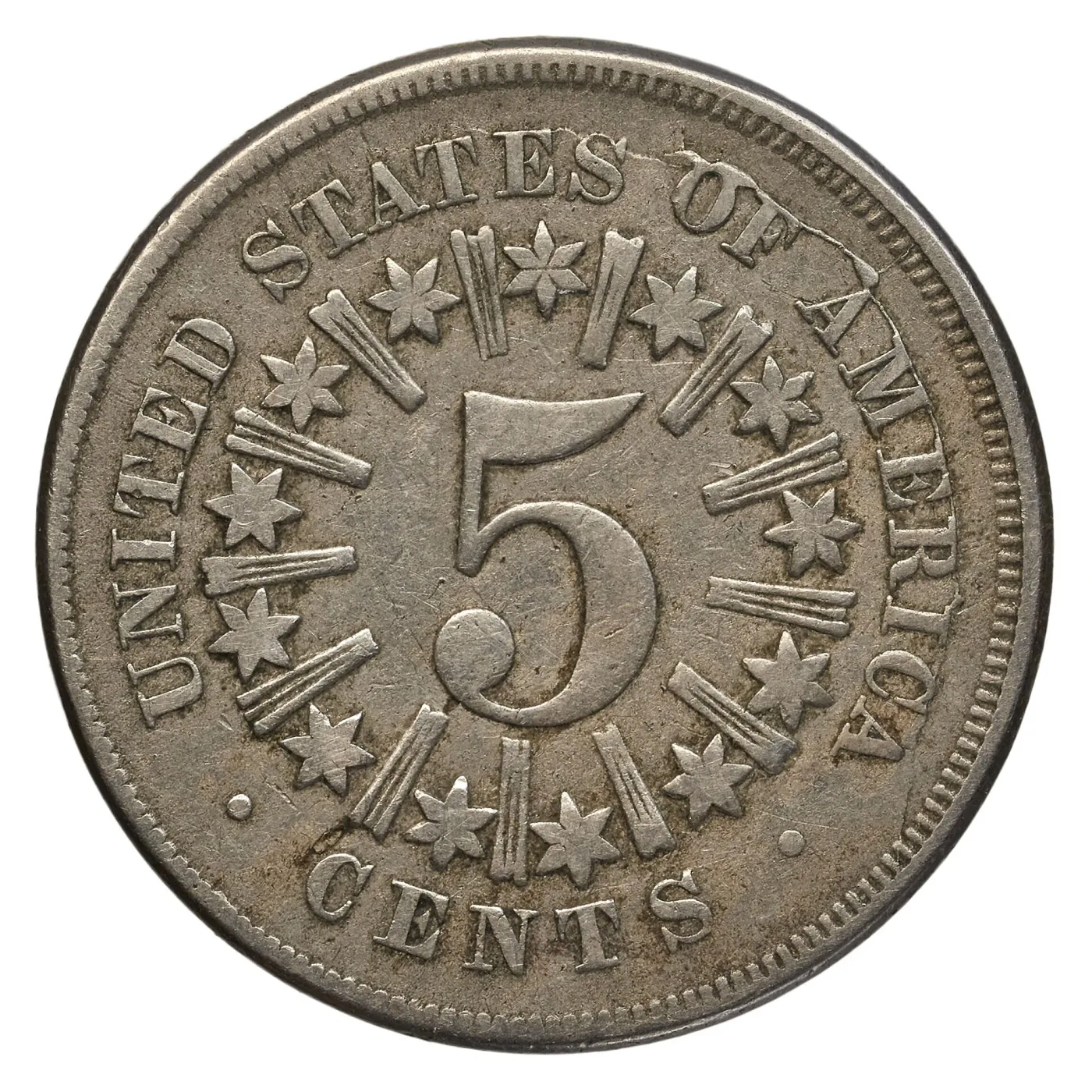
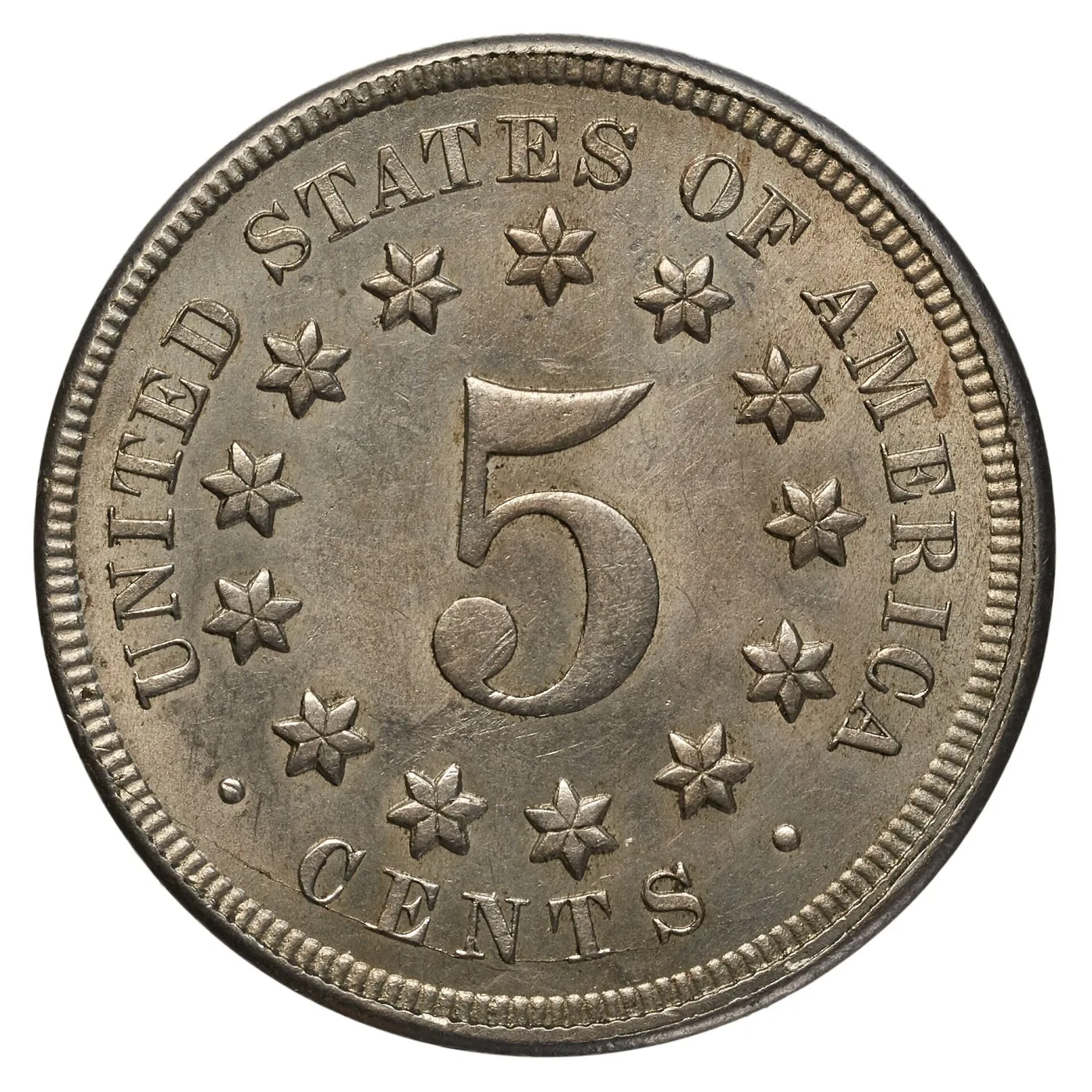
That is the whole test. There is no borderline case at the design level, because the two reverses came from different hubs: on one the gaps are filled and on the other they are empty, and no amount of toning, dirt or poor lighting turns one into the other. The stars themselves do not land in identical positions between the two, which is worth knowing only so you do not mistake the shift for a diagnostic. Read the gaps. One straight-on photograph of the reverse answers it, which is not true of most variety questions in US coinage.
Why the Obverse Cannot Answer It
The shield side never changed. The same shield, garland, motto and crossed arrows appear on every Shield nickel from the first 1866 to the last 1883. Only the date moves.
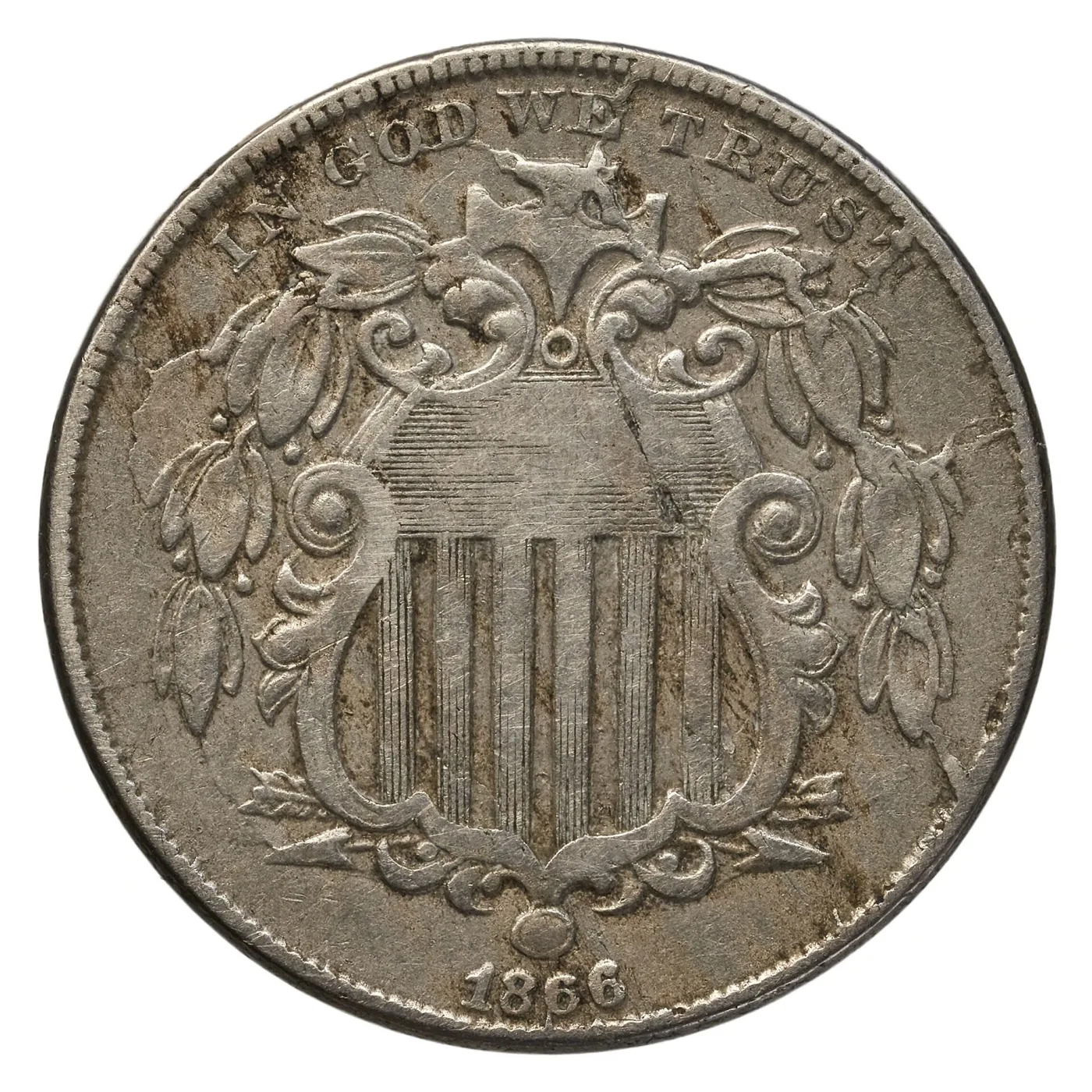
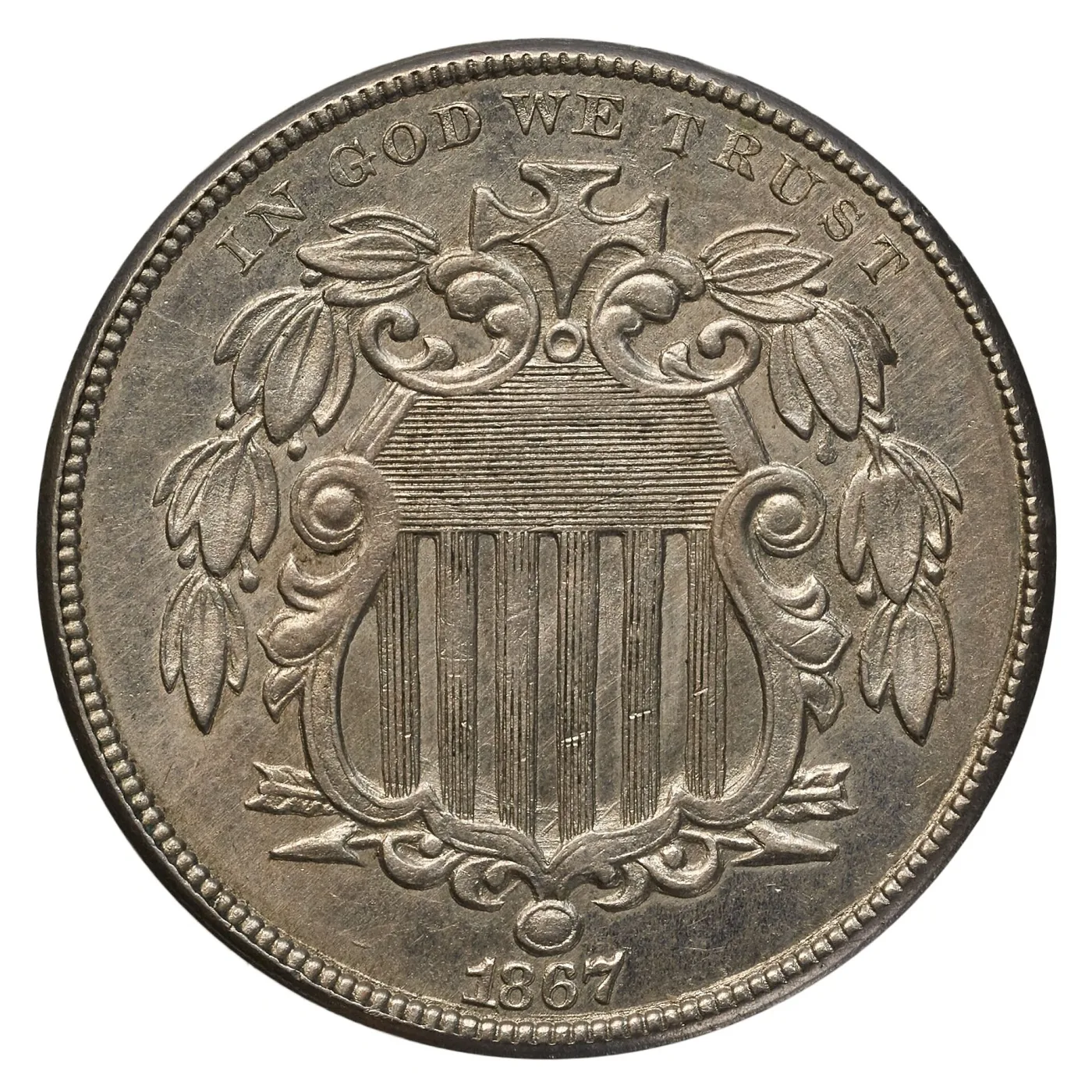
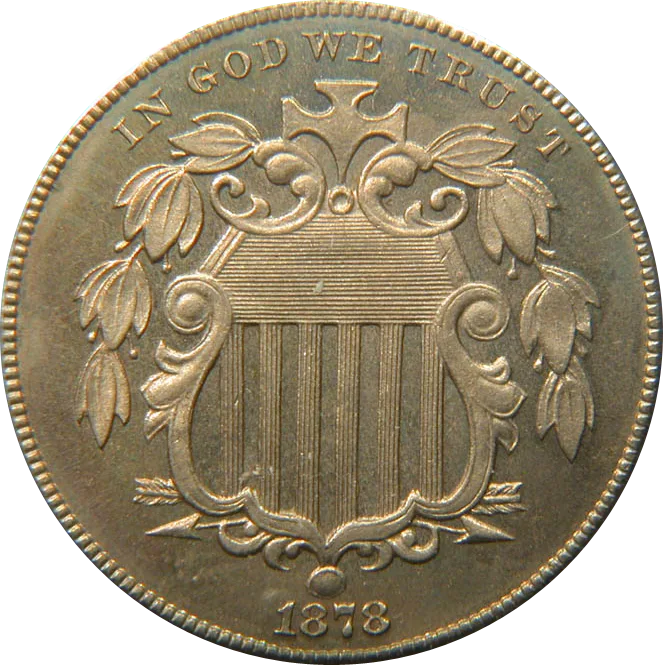
Nor is there a mint mark to fall back on. Every Shield nickel was struck at Philadelphia, which used none in this period, so the blank space some collectors go hunting for is simply how the coin is. Placement conventions for the series that do carry one are in our guide to reading mint marks.

Does the Diagnostic Survive Wear?
This is what decides whether a variety test is any use, because most Shield nickels that turn up loose are heavily circulated. Here the answer is worth seeing rather than being told.
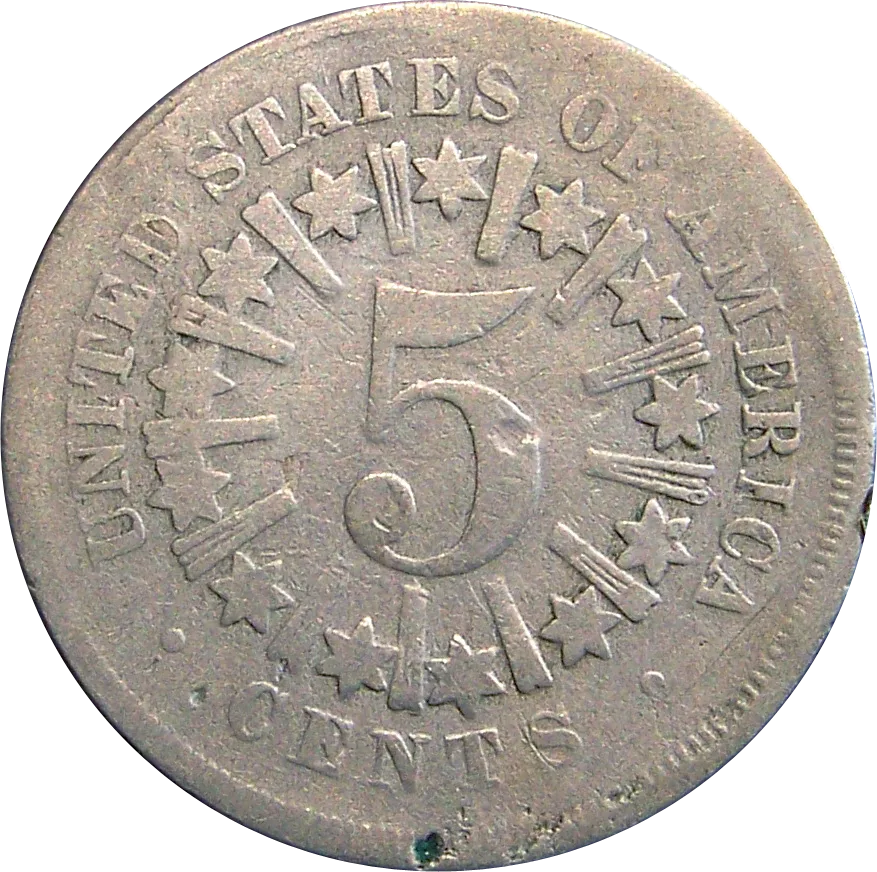
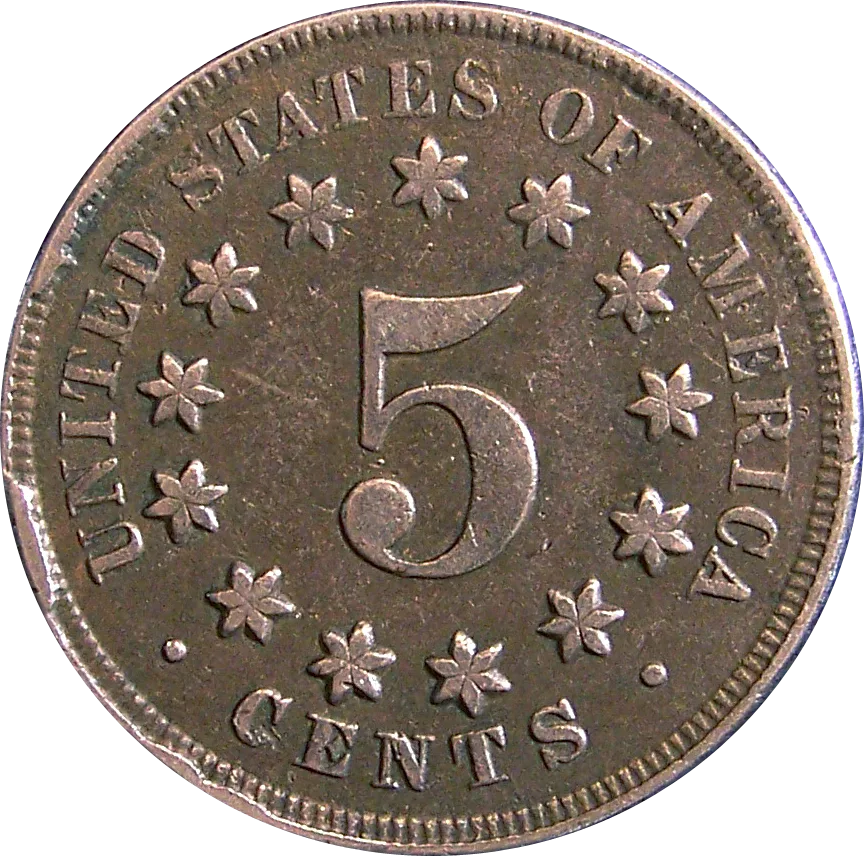
The test holds up because it does not ask you to read fine detail. It asks whether an area of the coin is occupied or empty, and wear removes height before area. A ray group can lose most of its relief and still leave a broad ridge where the No Rays die left nothing.
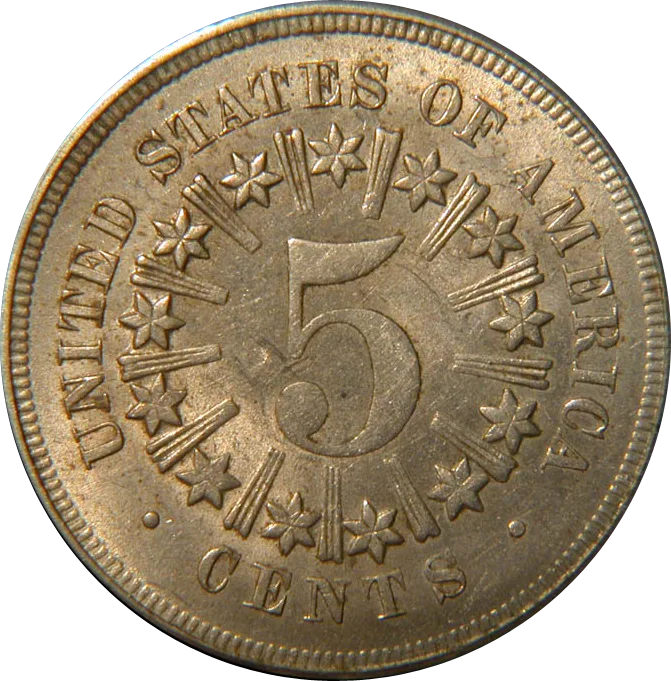
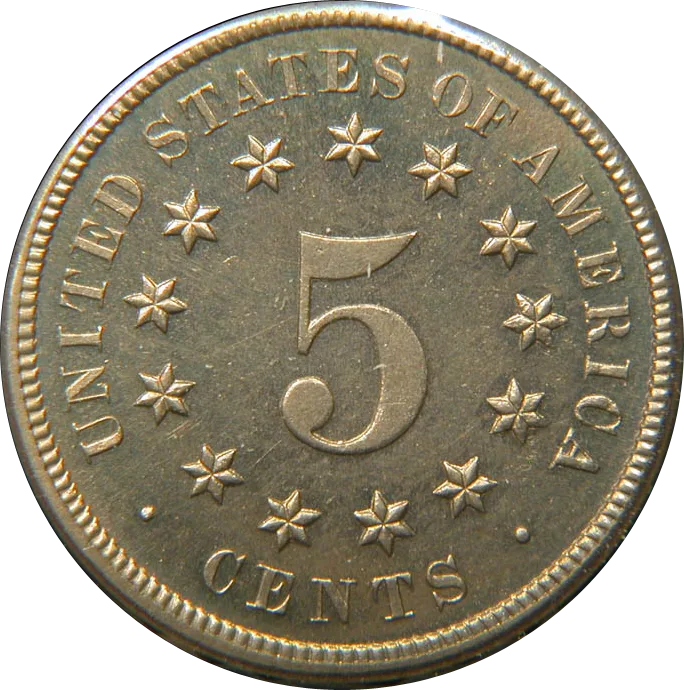
The one case that genuinely defeats the test is a coin worn nearly smooth, where the reverse is a disc with a faint 5. By then the date has usually gone too, and there is no premium left to protect.
The 1866-67 Mintages, Split by Variety
These are the only three issues where the question arises. The last two columns do the work: each row’s share of every Shield nickel dated 1866 or 1867, and its share of its own date. Those proportions describe what you are likely to be holding better than a raw mintage does.
| Issue | Reverse | Business strikes | Proofs (estimated) | Share of all 1866-67 nickels | Share of its own date |
|---|---|---|---|---|---|
| 1866 | With Rays | 14,742,500 | about 600 | 32.3% | 100% |
| 1867 With Rays | With Rays | 2,019,000 | about 25 | 4.4% | 6.5% |
| 1867 No Rays | No Rays | 28,890,500 | about 600 | 63.3% | 93.5% |
| All 1866-67 | — | 45,652,000 | — | 100% | — |
Read across the bottom two columns and the shape of the thing appears. Out of every 1,000 Shield nickels dated 1866 or 1867, about 323 are 1866s, 633 are 1867 No Rays, and 44 are 1867 With Rays: roughly one in twenty-three. Within the 1867 date alone the split is 6.5% against 93.5%. And of all 16,761,500 With Rays nickels ever struck, only 12% carry the 1867 date, because 1866 alone produced more than seven times as many.
At 28,890,500 pieces the 1867 No Rays is also the largest single issue of the whole series, just ahead of the 28,817,000 struck in 1868. The hardest Shield nickel variety to find and the easiest share a date.
Treat the proof column as an estimate, because it is one. Shield nickel proof mintages before 1878 are modern reconstructions rather than recorded figures, and they are not agreed: the 1867 With Rays proof is put at about 25 pieces by the usual references and at 25 to 75 by others, and the 1866 run is given variously as roughly 500 or 600. The business-strike numbers above are Mint records, quoted consistently everywhere; the proof numbers are not, and a source that prints them without a qualifier is being tidier than the evidence. Our guide to identifying proof coins covers how a proof is told from a business strike in the first place.
By mintage the 1867 With Rays is not the scarcest Shield nickel; the 1880, at 16,000 business strikes, is in another category. What makes it the one people get wrong is that it hides inside a common date, which is the trap key dates generally set.
What It Is Worth, and What Actually Gets Faked
Published price guides disagree about Shield nickels more than you might expect: three current sources give circulated 1867 With Rays figures that differ by a factor of two at the same nominal grade, and diverge further in Mint State. What they do agree on is the ratio, and that is the number worth carrying: in circulated grades the With Rays runs roughly one and a half to three times the No Rays, and in Mint State the gap opens to something like four to seven times. Enough to be worth ten seconds of looking, not enough to make a worn 1867 a life-changing find. Year-by-year values are in the full Shield nickel identification guide.
The premium raises the obvious question about fakes, and the answer is more reassuring than for most varieties. The rays stand above the field, and a graver removes metal rather than adding it, so they cannot be engraved onto a No Rays coin. Adding them means adding metal, which leaves a join visible under a loupe and usually disturbs the weight. A genuine Shield nickel weighs 5.00 grams, measures 20.5 mm and has a plain edge with no reeding; a documented contemporary counterfeit of an 1867 was caught at 4.2 grams. The broader method is in our guide to detecting counterfeit coins.
One last thing that trips people up online. Five-cent pieces dated 1866 without rays do exist, and photographs of them circulate freely. They are patterns, catalogued as Judd 507 to 509a, struck to test the design rather than to spend, and far rarer than any regular issue. An 1866 out of an old accumulation is a With Rays coin.
The Short Version
Read the date first. 1866 means With Rays, 1868 through 1883 means No Rays, and only 1867 needs a second look.
For an 1867, turn it over and look at the thirteen gaps between the stars. Filled with three short bars each, you have one of 2,019,000. Empty, one of 28,890,500. The series gave way in 1883 to the Liberty Head V nickel and its own famous confusion; this one, at least, is settled by looking.
Frequently Asked Questions
How do I tell a With Rays Shield nickel from a No Rays one?
Turn the coin over and look at the gaps between the thirteen stars that ring the numeral 5. On a With Rays coin each gap is filled by a group of three short raised bars. On a No Rays coin every gap is bare metal. Nothing else on either side of the coin changes, so this one feature settles it.
Which 1867 Shield nickel is the valuable one?
The With Rays. Philadelphia struck 2,019,000 of them before the design changed and 28,890,500 of the No Rays afterwards, so the No Rays outnumbers it more than fourteen to one. Published price guides disagree widely on the actual dollar figures, but they agree on the shape of the gap: roughly one and a half to three times the No Rays price in circulated grades, widening to several times that in Mint State.
Are all 1866 Shield nickels With Rays?
Every 1866 struck for circulation is, yes. Five-cent pieces dated 1866 without rays do exist, but only as patterns, the experimental pieces the Mint struck to test designs rather than to spend. They are catalogued separately as Judd 507 to 509a and are far rarer than any regular issue, so an 1866 you found in an accumulation is a With Rays coin.
Why were the rays removed from the Shield nickel?
The copper-nickel alloy was hard, the rays sat in deep recesses in the die, and forcing metal into them took pressure that cracked dies early and still left the coins weakly struck. Treasury Secretary Hugh McCulloch ordered the rays dropped on 21 January 1867 and the new reverse went into production on 1 February. A second explanation circulates in the hobby, that the stars-and-bars reverse read as Confederate imagery to a public three years out of the Civil War, and contemporary critics did say so, but the order itself was a production decision.
Do Shield nickels have mint marks?
No. Every Shield nickel from 1866 to 1883 was struck at Philadelphia, which used no mint mark in this period, so a blank space where you expect a letter is normal. That also means the rays are the only structural variety question in the series, since there is no branch-mint issue to identify.
Can rays be added to a No Rays coin to fake the variety?
Not by engraving, because the rays stand above the field and a graver can only cut metal away. Faking them means adding metal, which leaves a visible join under magnification and usually shifts the weight. A genuine Shield nickel weighs 5.00 grams and measures 20.5 millimetres across with a plain edge, and a documented contemporary counterfeit of an 1867 gave itself away at 4.2 grams.